
Award travel has transformed the way people approach flying. But travelers get confused at one point-when it comes to award pricing. For example, one airline might charge 80,000 miles for a business class flight while another program charges 120,000 miles for the exact same seat.
But how to identify this before transferring points? Comparing among programs is the key here. Without proper comparison, travelers may end up spending significantly more points than necessary.
Understanding how to compare award prices across airlines is therefore one of the most valuable skills in the world of points and miles. When done correctly, it allows you to identify the most efficient redemption options, maximize the value of your rewards, and unlock premium travel experiences for fewer points.
In this guide, we will explore everything you need to know about comparing award prices across airline programs.
Quick Summary
Before diving deeper, here is a quick overview of this article:
- Always compare the same route, date, and cabin class across programs.
- Check points as well as the additional cash fees required.
- Understand airline alliances and partner bookings.
- Look at transfer partners from credit cards.
- Identify sweet spots in airline programs.
- Use tools like Flightpoints to quickly compare programs and find the best redemption options for award travel.
Why Comparing Award Prices Matters
Award travel is unique because the price of a flight in points is not standardized. Unlike cash fares, airline loyalty programs price the same flight differently.
This happens because each airline has its own award pricing structure, redemption policies, and partner agreements. As a result, the number of miles required for a flight can vary significantly between programs.
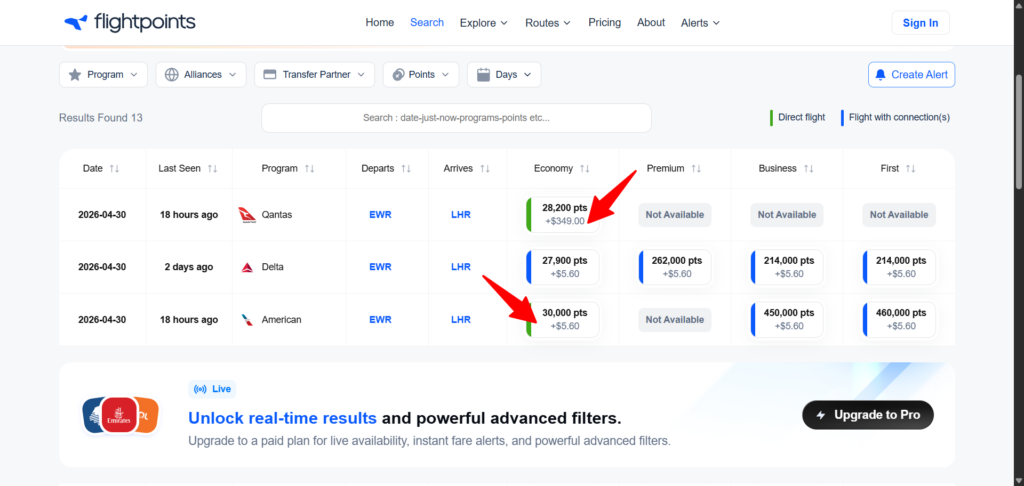
As you can see, the points required for a flight from New York to London have major differences in each program.
Even though Qantas require fewer points, the high fees make it less attractive than AA.
Comparing award prices ensure that you:
- Spend fewer points for the same flight
- Avoid programs with excessive surcharges
- Identify valuable redemption opportunities
- Maximize the overall value of miles
Before comparing award prices, it is actually important that you have an understanding of airline loyalty programs and alliances. If you have this basic knowledge, skip the next couple sections.
Understanding Airline Loyalty Programs
Every airline has its own frequent flyer programs that allow its members to earn and redeem miles. These miles can be accumulated through flights, credit card spending, hotel stays, and other travel partners.
Each airline program determines:
- How many miles are required for flights
- Which partner airlines can be booked
- What fees or surcharges apply
- What routing rules are allowed
Airline Alliances and Partner Airlines
Airline alliances are one of the most important aspects of award travel. It’s a really cool concept that benefits travelers as well as the operational side of airlines. Alliances allow airlines to cooperate and offer flights on each other’s network.
The three major alliances are:
- Star Alliance (26 member airlines)
- Oneworld (14 member airlines)
- SkyTeam (19 member airlines)
This is basic, but still just repeating (skip if you are not a beginner):
When you redeem miles through a loyalty program, you are often able to book flights operated by partner airlines within the same alliance.
For example, a traveler with United miles can book flights operated by Lufthansa or Air Canada because they are members of the same alliance. Which also means, the same Lufthansa flight can be booked using several different programs, each with its own award price.
Let’s break down the steps to compare award prices. Even though these steps might look basic for some people, these are actually skills that are used by experienced travelers when they book an award flight.
Step 1: Compare The Same Route And Date
The first rule of comparing award prices is to ensure that you are evaluating the same travel conditions. Make sure they are the same route, date, and cabin class. When these elements are identical, you are effectively comparing the same product.
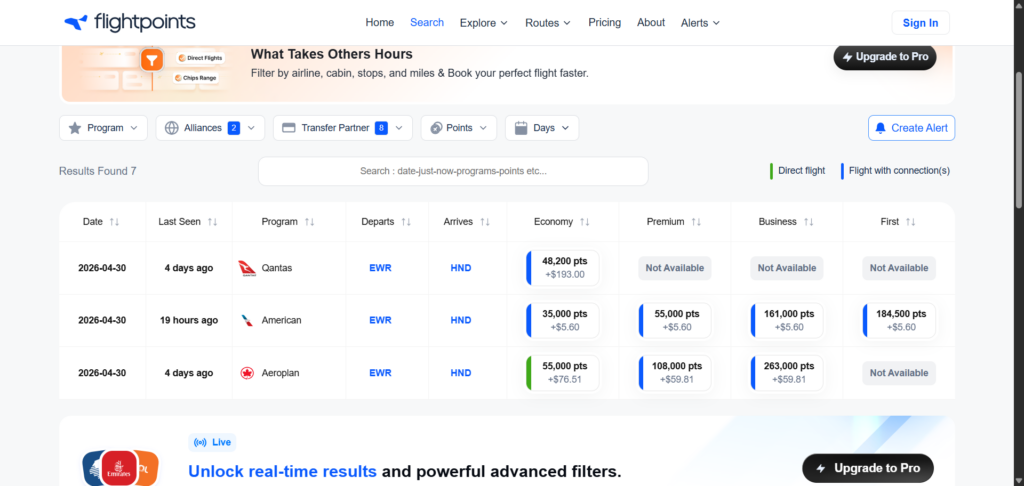
Step 2: Evaluate taxes and surcharges
You might have already seen, point bookings always include additional charges. These may include government taxes, airport fees, and fuel surcharges. Some airline programs add high surcharges that make the points less worthy.
So always evaluate the total cost, value of points saved, and whether the fees outweigh the points saved.
Step 3: Identify Award Pricing Models
Airline programs use different pricing systems when determining how many miles a flight costs. Understanding this will help you predict the points required. There are 2 main types of pricing models:
- Fixed Award Charts
Some programs use pricing based on distance or regions, called fixed charts. In these systems, flights between certain regions cost a predictable number of miles.
Benefits of fixed charts:
- Predictable pricing
- Opportunities for sweet spots
- Consistent redemption value
- Dynamic Pricing
Most airlines use dynamic pricing, where the number of miles required fluctuates based on demand.
Pros and cons of dynamic pricing:
- Prices can be significantly low sometimes
- Popular flights might require extremely high mileage
- Harder to predict pricing
Understanding which system an airline uses helps you anticipate whether comparing programs may reveal better deals.
Step 4: Calculate Redemption Value (CPP)
When comparing award prices, experienced travelers often calculate the redemption value of their points. This is measured using Cents Per Point (CPP).
Formula to calculate CPP:
(cash price – taxes) ÷ points used
Here’s a table to understand a good redemption. Higher CPP indicates good redemption value.
| CPP | Quality | Example | Action |
| 0.5 | Poor | Economy dynamic | Avoid/save points |
| 1.0 | Average | Economy saver | Accept if needed |
| 1.5 – 2.0 | Good | Business standard | Book confidently |
| 3.0+ | Great | Business sweet spot | Prioritize |
| 5.0+ | Elite | First class sweet spot | Book immediately |
Step 5: Check Transfer Partners
Many credit card reward programs allow points to be transferred to airline loyalty programs. Major examples include:
| Credit Card Program | Airline Transfer Partners |
| American Express Membership Rewards | Air Canada, ANA, Avianca |
| Chase Ultimate Rewards | United, Air Canada, Singapore Airlines |
| Capital One Miles | Air Canada, Turkish Airlines |
These are just a few examples. Check your credit cards airline partners while looking for award flights to discover many options.
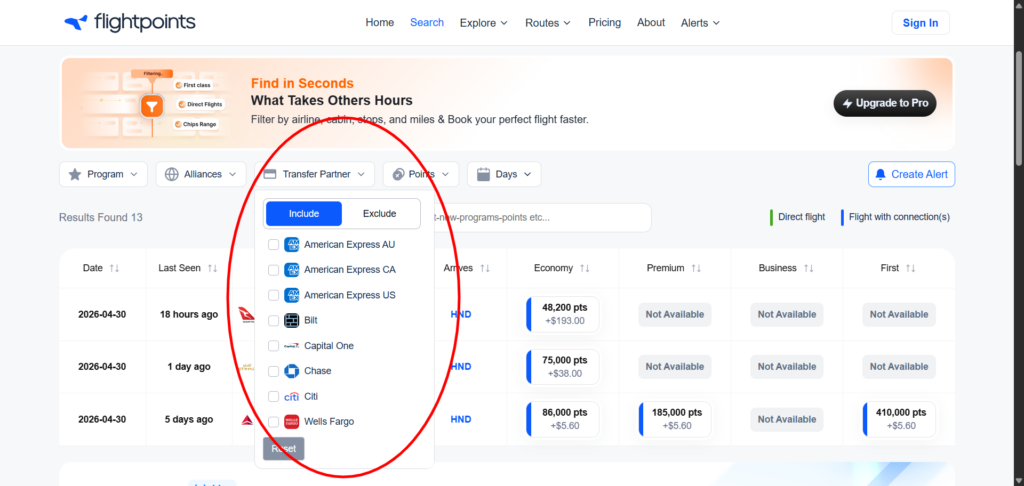
This flexibility is extremely valuable because it allows travelers to choose the program with the best award price. When comparing award prices, always check whether your credit card points can be transferred to the airline program offering the best redemption value.
Step 6: Analyze Award Availability
Airlines release a limited number of award seats on each flight. Availability varies across airline programs.
Factors affecting availability include:
- Travel seasons
- Airline restrictions
- Partner inventory access
Flightpoints give real-time availability updates with its live search feature. Pro users also get to filter their searches with advanced filters to streamline results according to specific travel requirements.
Common Mistakes To Avoid When Comparing Award Prices
Travelers tend to make errors when evaluating award options. Avoiding them can save thousands of miles.
- Ignoring taxes and surcharges
- Searching only one program
- Ignoring redemption value
- Overlooking partner airline options
How Flightpoints Simplifies Award Comparison
Comparing award prices manually can be extremely time-consuming. Travelers often need to search multiple airline websites individually, which makes the process inefficient and frustrating. This is where Flightpoints become an essential tool for award travelers.
Flightpoints simplifies the comparison process by aggregating award availability across multiple airline programs in one place. Key advantages include:
- Centralized award search.
- Real-time award availability.
- Easy comparison of points, fees, cabins, and airline partners as they are all shown side-by-side.
- Advanced filters. (these filters allow users to quickly refine their search and focus on the most valuable options)
Strategies To Improve Award Price Comparisons
- Be Flexible With Dates
Shifting your travel dates by a day or two can reveal significantly cheaper award prices.
- Book Early
Many airlines release award seats 330 – 360 days in advance. Booking early, or starting to look for award availability earlier increases the chances of finding best redemption options.
- Monitor Award Space
Award pricing changes frequently. Monitoring availability can reveal sudden drops in required miles.
- Combine Programs
Sometimes the best strategy involves booking different segments of a trip using different airline programs.
Airlines continue to evolve their loyalty programs. Many airlines have moved toward dynamic pricing, which can make award costs less predictable. However, opportunities still exist for travelers who know how to compare award prices effectively.
Conclusion
Comparing award prices across airlines is one of the most important skills in award travel. By comparing routes, evaluating taxes and fees, understanding airline alliances, calculating redemption value, and checking transfer partners, travelers can identify the most efficient award bookings.
While this process can be complex, award search tools like Flightpoints simplify the experience by allowing travelers to compare multiple airline programs in one place.
Upgrade to Flightpoints to make award travel easier and more rewarding.
FAQs
Q: Why is it important to compare award prices?
Comparing programs helps you find the most efficient redemption and avoid spending more points than necessary.
Q: Do transfer bonuses affect award price comparisons?
Yes. Transfer bonuses can reduce the effective number of points required, making certain airline programs more valuable for a specific redemption.
Q: Why do different airlines charge different points for the same flight?
Each airline loyalty program has its own award pricing system, which is why the same flight can cost different amounts of miles depending on the program used to book it.
Q: What should I compare when evaluating award flights?
You should compare points required, taxes and fees, airline partners, award availability, and the overall redemption value.