
Award seats disappearing can feel discouraging, especially when the plane still looks open and you planned ahead. If you are booking premium cabins or traveling with family, that moment carries real pressure. You did not miss something obvious. Most traveler’s face the same confusion.
Table of Contents
You might notice the same flight showing seats in one program, but not in another. That experience is common and understandable. Airline award availability is not designed to be intuitive, even for people who earn and use points often.
Airline award availability works through controlled inventory, scheduled releases, and airline-set rules. Seats are added and removed based on timing, demand, and booking behavior. When you understand this system, the process feels less random and more manageable.
In this blog, we explain airline award availability in clear terms, without shortcuts or gimmicks, so you can plan with confidence and avoid unnecessary frustration.
How Airline Award Availability Works, at a Glance
- Award seats come from a controlled inventory, not the visible seat map, which is why open planes still show no point options.
- Availability changes over time as airlines adjust seats based on demand, timing, and booking behavior, not traveler effort.
- Seeing award seats does not guarantee good value, especially in premium cabins where point costs can rise quickly.
- The same flight can appear in one program and disappear in another due to program access rules and timing differences.
- Better outcomes come from tracking timing and availability patterns, not from searching harder or transferring points faster.
What Airline Award Availability Actually Means
Airline award availability refers to the number of seats an airline chooses to make bookable using points or miles instead of cash. These seats come from a separate inventory pool and are not tied to how full the flight appears. When you search for award travel, you are not browsing a seat map. You are checking whether the airline has released any seats from this controlled pool, often with help from an award seat search platform.
Award availability is about access, not price. Even if you have enough points, you can only book seats the airline has opened for awards. That is why flights with many empty seats may still show no award options. Airlines release award seats in limited quantities and adjust them over time based on demand, timing, and internal targets.
To understand what you are actually seeing during an award search, keep these points in mind:
- Award seats are released intentionally and in small batches.
- Availability can change daily without notice unless you rely on award availability alerts.
- A visible cash seat does not imply a bookable award seat.
- Different loyalty programs may show different access to the same award route.
How Award Seats Differ From Paid Seats
Award seats and paid seats serve different purposes inside an airline’s system. One is designed to generate cash revenue. The other is meant to manage loyalty demand while protecting revenue. Understanding the contrast helps you interpret search results with more confidence.
Here is how award seats differ from paid seats in practice:
- Inventory control: Paid seats pull from the full cabin inventory. Award seats come from a separate, airline-controlled pool.
- Seat count: Cash bookings can access nearly every seat. Award bookings are often limited to a small number per cabin.
- Change behavior over time: Paid seats usually decrease as departure nears. Award seats may appear, disappear, or return at any point.
- Visibility across programs: Cash seats look the same everywhere. Award seats can appear in one loyalty program and not another.
This difference explains why award searches require patience and system awareness, even when cash availability looks wide open.
How Airline Award Availability Works Step by Step
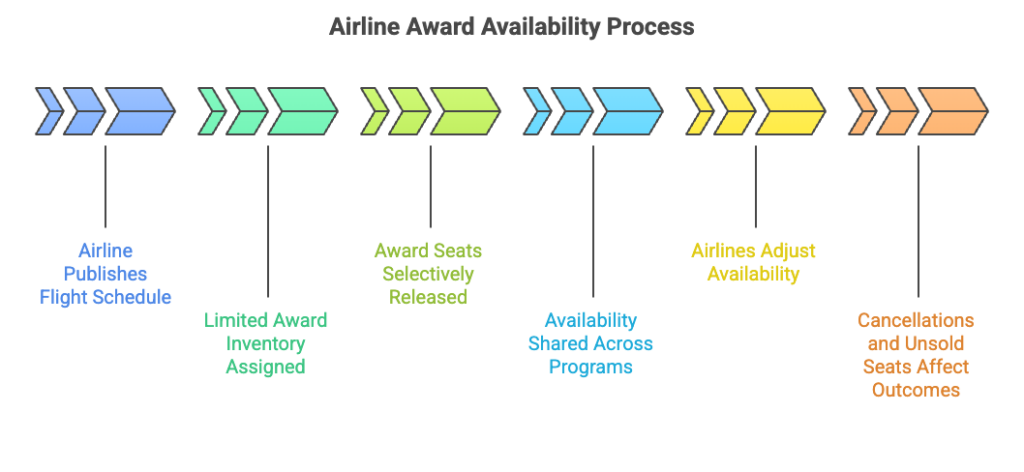
Airline award availability follows a structured sequence controlled by airlines, not by how many points you hold. Understanding this sequence makes changes in availability easier to anticipate and less frustrating.
Step 1: The Airline Publishes its Flight Schedule
Once an airline loads a new schedule, flights become visible for booking. This usually happens 330 to 360 days before departure. At this stage, award seats are not fully released. The schedule opening only signals that the flight exists.
Step 2: A Limited Award Inventory is Assigned
After the schedule appears, airlines allocate a small number of seats for point-based bookings. This inventory is separate from paid seats. Premium cabins usually receive fewer award seats at this point.
Step 3: Award Seats are Selectively Released
Airlines release award seats in controlled batches. Some seats appear early. Others are held back. This decision depends on route demand, cabin type, and expected cash bookings. Award availability platforms like FlightPoints help surface which seats are actually released at this stage.
Step 4: Availability is Shared Across Programs
Released award seats are distributed to the airline’s own program and selected partner programs. Not all programs receive the same access. This explains why availability can appear in one place but not another.
Step 5: Airlines Adjust Availability Over Time
As bookings come in, airlines reassess performance. Award seats may be added, removed, or repriced. These changes can happen weeks, days, or even hours before departure, which is why many travelers rely on award availability alerts from tools like FlightPoints.
Step 6: Cancellations and Unsold Seats Affect Outcomes
When travelers cancel award bookings or flights underperform in cash sales, seats may return to award inventory. These reappearances are unpredictable but common.
This step-by-step cycle repeats until departure. Airline award availability feels random only when this process is invisible.
How Airlines Decide Airline Award Availability
Airlines manage award availability to balance loyalty demand with revenue goals. You are not being blocked at random. Each airline sets aside a limited number of seats that can be booked with points while keeping most inventory focused on paid travel. This approach allows airlines to reward loyalty without risking empty premium cabins or lost cash sales.
At a high level, airlines use yield management to decide how seats are distributed. This means they estimate future demand and control how many seats are released for awards at different times. Scarcity is intentional. If every seat were available for points from day one, airlines would lose pricing control and revenue stability.
To understand how these decisions affect your searches, keep the following factors in mind:
- Airlines protect high-demand routes and dates by limiting award seats early.
- Award inventory is reviewed and adjusted as booking patterns become clearer.
- Premium cabins receive tighter control due to higher revenue expectations.
- Award availability decisions focus on overall flight performance, not individual travelers.
This structure explains why award seats can feel unpredictable, even when you are searching well in advance.
Waiting for award seats to open? Set up FlightPoints alerts to get notified when real availability appears on your routes and cabins. Set your alerts with FlightPoints and book with confidence.
Why Only a Few Award Seats Are Released Early
Early award availability reflects cautious planning rather than restriction. When schedules first open, airlines have limited data on demand. Releasing too many award seats too soon would reduce flexibility later. This is especially true for business and first class cabins.
Here are the main reasons early award space is kept tight:
- Airlines reserve most premium seats for paid bookings until demand becomes clearer.
- Early award seats act as a controlled test of loyalty interest.
- Long-haul and popular routes receive stricter limits than low-demand flights.
- Additional seats are often held back for closer-in evaluation.
Understanding this pattern helps you set realistic expectations when searching early. Limited availability at the start does not mean seats will never appear, especially when you track changes over time with award seat finder tools like FlightPoints.
When Airline Award Availability Opens and Changes
Airline award availability follows predictable time windows, but the seats within those windows are not fixed. Most airlines open award booking calendars about 330 to 360 days before departure for many long-haul award routes. When you see a flight appear that far out, it signals that the schedule is open, not that all award seats are ready to book.
Planning early helps, but early access does not guarantee lasting availability. Award seats are released in small quantities and reviewed often. As travel dates approach and demand becomes clearer, airlines adjust what remains open for points. This is why availability can change even when you check the same flight repeatedly.
To plan with these timing patterns in mind, focus on the following behaviors:
- Award calendars open well before airlines commit full inventory.
- Early availability is usually limited, especially in premium cabins.
- Seats can be removed or added as booking activity changes.
- Waiting too long can reduce options even if points are ready.
Understanding these windows helps you plan searches more strategically instead of assuming early access equals security.
Early Release vs Close-In Availability
Timing matters more than your points balance. You can hold a large number of points and still miss out if you search at the wrong time. Award availability tends to move in cycles, not straight lines.
Here is how award availability commonly shifts over time:
- Early window behavior: A small number of award seats appear when the schedule opens, often favoring economy cabins.
- Mid-cycle pullbacks: Airlines may remove seats if paid bookings increase or demand spikes.
- Close-in releases: Unsold seats are sometimes added back weeks or days before departure.
- Cancellation-driven reappearances: Award seats can return when other travelers cancel bookings, often triggering award seat release notifications.
Tracking these patterns helps you stay patient and recognize when renewed availability is more likely to appear.
Saver vs Higher-Priced Awards and Airline Award Availability
Airline award availability does not always reflect good value. You may see seats open for points, yet the number of points required can vary widely for the same flight. This difference exists because airlines release award seats at different pricing levels, even when availability looks similar on the surface.
Saver-style awards refer to seats offered at the lowest point cost an airline is willing to accept. These seats are limited and usually released in small numbers. When saver seats are gone, airlines may still show availability through higher-priced options. With dynamic pricing, availability becomes more visible, but value often drops. This effect is strongest in premium cabins, where point costs can increase sharply even though the seat itself has not changed.
To understand how availability and value separate, keep these factors in mind:
- Saver-style seats offer the highest value but appear in limited quantities.
- Higher-priced awards expand access without protecting point efficiency.
- Dynamic pricing can make availability look better than it truly is.
- Premium cabins experience the largest swings in point cost.
Seeing seats does not automatically mean you should book them, which is why many travelers use FlightPoints to compare value before committing points.
Airline Award Availability by Airline and Program
This table helps you compare airline award availability patterns without treating them as fixed rules. Award release behavior changes based on demand, route, season, and cabin type. Use this table as a planning reference, not a promise of what will appear for your exact trip.
When reading the table, focus on timing ranges and general behavior. A longer booking window does not guarantee more seats. Premium cabins often follow different release patterns than economy seats, even on the same flight. Availability can also vary depending on whether you book through the airline’s own program or a partner.
Use the table below to set expectations and plan search timing more accurately:
| Airline | Typical Award Release Window | Pricing Style | Premium Cabin Notes |
| Air Canada | 355 to 360 days | Mixed with dynamic elements | Business seats appear early but drop quickly |
| Air France KLM | Around 359 days | Dynamic | Premium seats fluctuate often |
| American Airlines | Around 331 days | Mostly dynamic | Business seats can appear and vanish fast |
| British Airways | Around 355 days | Fixed with surcharges | Predictable release but limited premium seats |
| Delta Air Lines | Around 331 days | Fully dynamic | Premium seats appear close to departure |
| Emirates | Around 328 days | Dynamic | Premium seats available but point costs vary |
| Lufthansa | Around 360 days | Fixed saver plus higher tiers | First class often opens closer to departure |
| Singapore Airlines | Around 355 days | Fixed saver with controls | Premium seats tightly managed |
| United Airlines | Around 337 days | Mixed pricing | Premium availability varies by route |
Keep these usage guidelines in mind:
- Treat release windows as observed behavior, not guarantees.
- Premium cabins often follow separate timing from economy.
- Partner access can shift visibility even within these ranges.
This approach helps you plan searches without relying on assumptions that lead to missed opportunities.
Spending hours searching with no clear direction? FlightPoints routes help you focus on routes with real award availability instead of guessing. Browse award routes now!
Common Mistakes People Make With Airline Award Availability
Most mistakes around airline award availability are predictable. They come from time pressure, overconfidence, or trying to simplify complex decisions too quickly. As an experienced points earner, you are not missing basics. The risk comes from decisions that feel efficient in the moment but lock in poor outcomes.
These mistakes show up most often during high-stakes bookings. Premium cabins, family travel, and fixed dates on priority routes reduce flexibility . When availability feels scarce, it is easy to choose speed over structure. That is when points loss becomes permanent rather than theoretical.
Keep these patterns in mind as you plan:
- Complex trips encourage shortcuts that hide better options.
- Large point balances create false confidence in value.
- Time pressure leads to irreversible transfers and bookings.
- Familiar tools can limit visibility without warning.
Recognizing these patterns early helps you slow down before committing or wait for award seat availability notifications.
Mistakes That Cost the Most Points
The most expensive mistakes usually involve decisions you cannot undo. Once points are transferred or bookings are made, flexibility drops sharply. These errors often feel reasonable at the time, which is why they repeat.
Watch for these high-impact missteps:
- Portal overuse: Booking through card portals trades simplicity for steep point loss on premium flights.
- Blind transfers: Moving points without confirmed availability locks you into one program.
- Single-program searches: Checking only one loyalty program hides partner access.
- Waiting too long for perfect seats: Holding out can cause all viable options to disappear.
Avoiding these mistakes protects both your points and your future booking choices, especially when award flight booking platforms like FlightPoints help you confirm availability before acting.
How Tools Change How You Work With Airline Award Availability
Award availability software changes award travel by reducing guesswork, not by replacing judgment. They help you see patterns that are difficult to track manually. When used well, tools shift your focus from constant searching to informed decision-making.
The most useful tools focus on three areas:
- Alerting: Award availability alerts when seats appear or return.
- Comparison: Side-by-side views of the same flight across programs.
- Timing support: Visibility into when availability changes.
This approach reduces time spent refreshing searches and lowers decision fatigue. Instead of reacting to whatever appears first, you gain context before acting. That context becomes critical when booking premium cabins across high-value routes or multiple seats , where one mistake multiplies cost.
Tools do not eliminate complexity, but they make it manageable. The next step is choosing guidance that helps you act at the right moment, not just see more data.
How FlightPoints Simplifies Airline Award Availability
Airline award availability becomes difficult when you are forced to piece together partial information from multiple programs. FlightPoints removes that friction by acting as a clarity layer between your points and your booking decision. You are not handed more data. You are given clearer direction at the moment decisions matter most.
Instead of guessing which seats are real and which options lead to poor value, FlightPoints focuses on visibility and structure. It shows award availability that actually exists, compares transfer paths before you commit points, and supports planning for more than one passenger. This matters most for premium cabins, where small timing errors carry high costs.
Here is how FlightPoints directly addresses earlier pain points:
- Real availability visibility: You see award seats that can be booked, not theoretical options.
- Transfer path comparison: You compare transfer choices before points leave your account.
- Multi-passenger planning: You evaluate whether enough seats exist for family or group travel.
- Premium cabin focus: The system prioritizes high-impact bookings where value differences matter most.
This approach mirrors how a points-to-premium travel optimizer reduces analysis paralysis. You spend less time cross-checking programs and more time acting with confidence. Instead of reacting to scarcity, you plan around it.
Conclusion
Airline award availability is not confusing because you lack effort or knowledge. It feels difficult because airlines manage seats through controlled systems that are rarely visible to travelers. Missed value usually comes from structure, not mistakes.
Once you understand how availability opens, shifts, and disappears, the process becomes more predictable. You stop chasing every seat and start choosing better moments to act. That shift alone can protect thousands of points over time.
Smarter planning starts with clearer visibility and better timing. FlightPoints helps you see real award availability, compare options before transferring points, and act with confidence instead of guesswork. Sign up to explore award availability with FlightPoints, and when you are planning a high-stakes trip, upgrade to FlightPoints Pro for deeper visibility, alerts, and premium cabin planning support.
How often should you check airline award availability for a specific trip?
Daily manual checks are inefficient. Weekly monitoring works for early planning, while close-in travel benefits from continuous automated tracking.
Can airline award availability differ by passenger count on the same flight?
Yes. A flight may show one award seat but block searches for two or more passengers. Inventory is released per seat, not per booking.
Does airline award availability change after transferring credit card points?
It can. Availability may disappear between search and transfer completion. This risk increases during peak travel periods and premium cabin demand.
Why do mixed cabin award bookings sometimes appear when full cabin awards do not?
Airlines may release partial inventory across cabins. This allows one segment in business class and another in economy using a single award.
How does airline award availability affect cancellation and rebooking strategy?
Availability shifts can make rebooking difficult after cancellation. Securing alternative options before releasing an existing award reduces exposure.