
Many travelers redeem points without realizing they are getting it in poor value. They might book a flight that costs a large number of miles when the same flight could have been booked for significantly fewer points through another program. This gap between average and exceptional value is where sweet spots in award travel come into play.
A sweet spot is not just a “cheap” redemption. It is a strategic opportunity where points deliver disproportionately higher value. Understanding how to identify and use these opportunities is one key skill in booking award flights.

This guide will walk you through everything you need to know about sweet spots in award travel, so you can consistently find and book high-value redemptions.
Quick Summary
- Sweet spots are high-value redemptions where you only need fewer points than usual.
- Sweet spots in award travel can be found through partner programs, fixed award charts, and strategic pricing differences.
- It offers 2x-5x more value per point compared to average redemptions.
- Sweet spots are most common in business class and long-haul flights.
- Identifying sweet spots efficiently requires comparison across programs.
- Award search tools like Flightpoints help uncover sweet spots in real-time.
What Is a Sweet Spot In Award Travel?
In simple words, a sweet spot in award travel is a redemption where you get more value for your points compared to a typical booking. Instead of paying a high number of points, you will be able to book the same or similar flight for much fewer points through a smarter strategy.
Sweet spots are created because airline loyalty programs do not follow a universal pricing model. Each program has its own way of pricing award tickets. Some rely on dynamic pricing that fluctuates with demand, while others use fixed award charts based on regions or distance. These differences create pricing inefficiencies.
For travelers who understand the pricing differences, sweet spots become opportunities to extract maximum value. For example, instead of spending 200,000 points for a business class seat, you might have a chance to find the same seat for 60,000-70,000 points through a partner program.
Why Sweet Spots Matter In Award Travel
- One big advantage of sweet spots is the ability to increase your travel frequency. When you consistently book high-value redemptions, your points last longer, allowing you to take more trips over time.
- Another key benefit is access to premium travel experiences. Business and first class are often priced disproportionately high in cash, but can become accessible through sweet spots. Which means, you enjoy luxury, without paying luxury prices.
- Additionally, sweet spots help you avoid the frustration of poor redemptions. Instead of second-guessing whether you used your points wisely, you can book with confidence knowing you are getting strong value.
How Sweet Spots Are Created In Award Travel
Sweet spots exist because of the pricing structures in airline programs. Understanding these underlying mechanisms helps you identify opportunities more effectively. They are listed below:
- Fixed Award Charts
Though most programs now follow a dynamic pricing, some still use fixed award charts where flights are priced based on distance or region rather than demand. This means the cost remains stable regardless of how expensive the ticket is in cash.
Let’s take a real example.
Let’s say you want to fly from Tokyo to Heathrow in Air Canada.
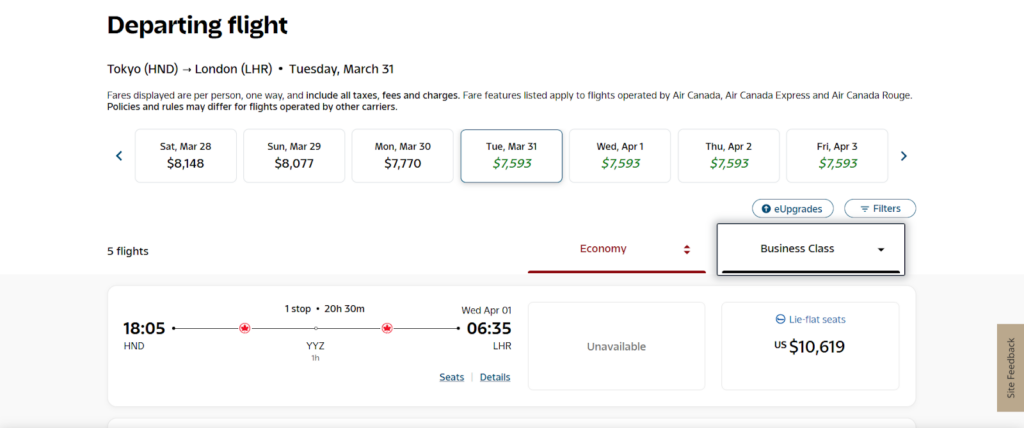
As you can see, a business class seat costs $10,619 in cash.
But you can go for the same route using Aeroplan miles, which mostly follows a fixed chart pricing.
If you go to Flightpoints and search the route:
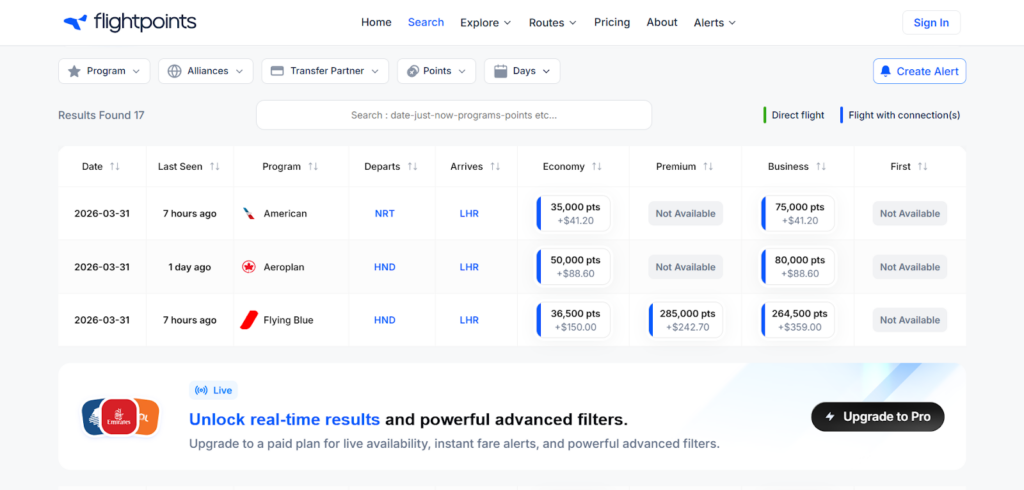
With Aeroplan, HND to LHR requires 80,000 points + $88.60 extra fees.
Let me tell you exactly why this is a sweet spot. For this, first you have to calculate the value of the redemption. The formula to calculate this is (cash price – fees) ÷ points used.
Step 1: Remove the cash portion
$10,619 – $88.60
= $10,530.40
This is the value you are getting from points.
Step 2: Value per point
$10,530.40 ÷ 80,000
=$0.1316 per point
Which means, 13.16 cents per point.
The typical Air Canada Aeroplan value is 1.5 to 2.0 cents per point. But the value we got here (13.16 cents) is 6x to 8x higher than normal. Now this is a rare sweet spot! The points required do not reflect the actual market value.
- Partner Airline Pricing Differences
Airlines operate within alliances, and each program has its own pricing for partner airlines. This is a great source for sweet spots in award travel. A flight operated by one airline may be significantly cheaper when booked through a partner program. The difference can be massive, especially if it’s a long-haul flight or a premium cabin flight.
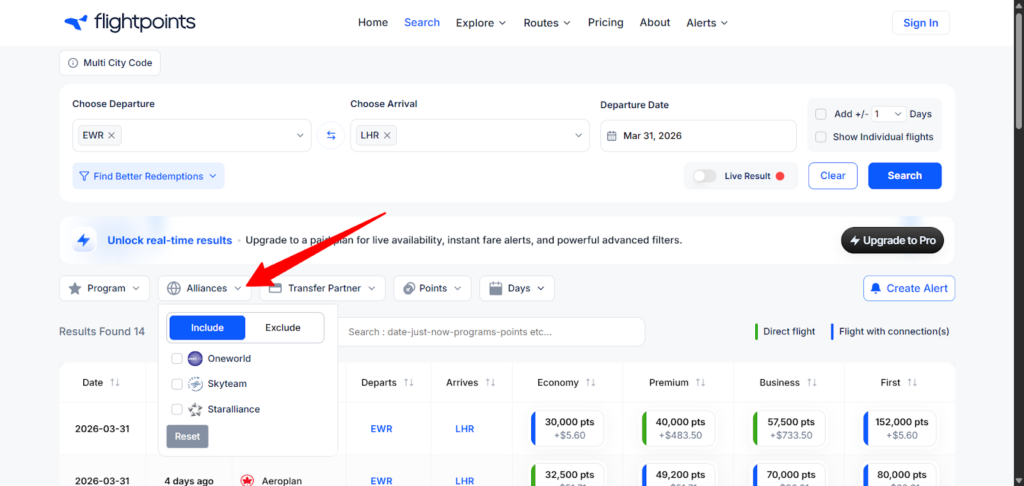
While searching for award flights on Flightpoints, just click on each alliance to see the points cost difference to discover sweet spots.
- Distance-Based Pricing
Some programs price flights purely based on the distance. This creates opportunities where certain routes fall into lower pricing tiers despite offering high value.
That is, a route just under the threshold may cost significantly fewer points than a slightly longer route, even if the experience is similar.
- Market Innefficiencies
As you might have noticed by now, airline pricing systems are not perfectly aligned. Differences in demand, partnerships, and regional strategies create inconsistencies that can be leveraged. These inefficiencies create great redemption opportunities.
Even though there were tips for spotting sweet spots in the above sections, let’s take a quick look at key strategies.
How To Identify Sweet Spots in Award Travel
Identifying sweet spots in award travel is a skill that improves with practice and the right approach. But this can also be very beginner friendly if you use the small tips discussed here and apply it on a good award search tool. Flightpoints is the best award search tool that is both beginner and advanced travel friendly.
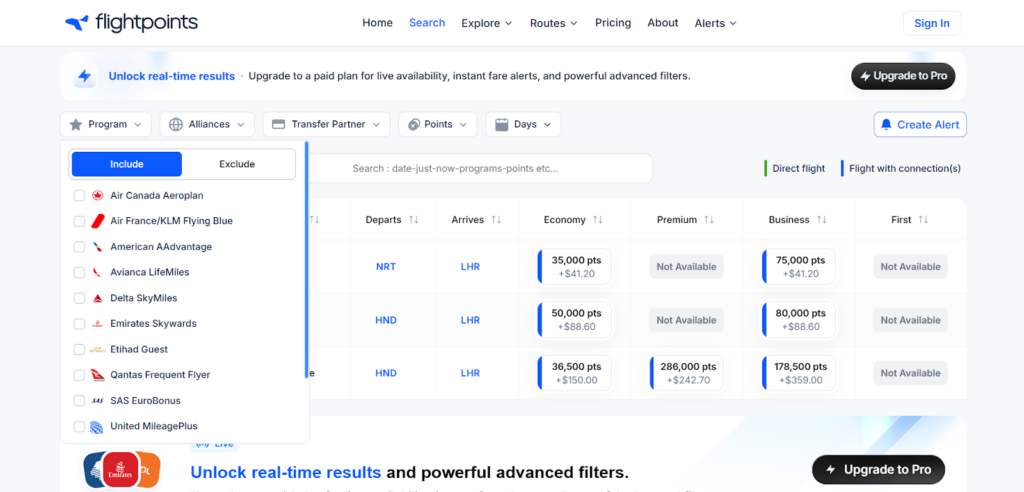
Flightpoints simplify award flight searches, making sweet spots easy to spot without manual checking across sites. It shows real-time values from all programs in one place. Here are a few tips to keep in mind:
- Compare Multiple Programs
Always compare different airline programs before booking. Pricing differences can be significant, and relying on one program could limit your options.
- Calculate Point Value
Calculating the value of points helps you determine whether a redemption is worth it. The measure is called CPP, which stands for Cents Per Point. The formula is: (Cash price – taxes/fees) ÷ Points required x 100. A higher CPP indicates better value.
- Look For Fixed Chart Programs
One benefit of focusing on programs with fixed charts is that they are more predictable and often contain valuable sweet spots.
- Use Award Search Tools
As discussed above already, manually comparing multiple programs can be time consuming. Flightpoints simplifies this process by aggregating results and showing you the best options for award flights instantly.
You can also create alerts to get notified whenever there is an availability or a price drop. On Flightpoints, you can set filtered alerts according to your preferences.
Comparing Manual Search vs Flightpoints
| Feature | Manual Search | Flightpoints |
| Time required | High | Low |
| Accuracy | Medium | High |
| Program comparison | Limited | Extensive |
| Ease of use | Complex | Simple |
An ideal workflow when searching for award flights on Flightpoints:
- Search route
- Compare programs
- Check fees
- Identify best option
- Transfer points
- Book immediately
Strategies to Maximize Sweet Spots in Award Travel
Finding sweet spots is only the first step. Using them effectively requires strategy. Here are a few techniques you can use to maximize the value of your points.
Be Flexible
Flexibility is one of the most powerful tools in award travel. Sweet spots do not always appear on your exact preferred dates or routes. Being open to small adjustments can possibly make a great difference in the value of your points. It only requires you to shift your travel by a day or two.
Flexibility can apply in many ways:
- Dates: Travelling mid-week instead of weekends often reveals better availability.
- Airports: Checking nearby airports may open up better redemptions.
- Routes: Taking a connecting flight instead of direct may reduce point cost.
Use Transfer Bonuses
Transfer bonuses is another way to enhance a sweet spot. Sometimes, credit cards offer a bonus (like 20%-30%), where you receive more miles for the same number of points. This reduces your point cost. But a bonus is not an all time thing.
- If your travel is not urgent, wait for a bonus before transferring points.
- You can combine bonuses with already low-cost partner redemptions.
- Always confirm availability before transferring.
Book One-Way Tickets
Booking one-way tickets instead of round trips gives you much more control over your redemption strategy. Award pricing is often inconsistent between outbound and return journeys, and combining them into one booking can force you into higher total cost.
Monitor Availability
Award availability is dynamic and changes very frequently. Airlines release and remove award seats based on demand, making it important to track changes over time. A flight that is expensive today might become a sweet spot tomorrow if additional seats are released.
Using tools like Flightpoints can simplify monitoring by allowing you to track and set alerts for availability and price drops. Checkout the alerts page to see the advanced filters you can use for alerts.
When Is a Sweet Spot Not Worth It
Not every low-point redemption is a good deal. Some may involve:
- High fees
- Poor routing
- Long layovers
So, make sure to evaluate the total cost rather than focusing only on points.
Advanced Sweet Spot Techniques For Award Travel
These techniques are commonly used by experienced travelers to reduce point costs further, increase flexibility, and unlock great redemption values.
One has been already discussed above, combining multiple programs. Combining different programs for outbound and return flights can give you access to more options at a lower point cost.
Using Stopovers
Stopovers are one of the most underrated ways to increase the value of your points. Some airline programs allow you to add a stopover. A stopover is an extended layover in another city, which doesn’t require additional points, or only a minimal increase in points.
Why stopovers are valuable:
- Maximize travel experience without extra points
- Turn a standard redemption into a multi-destination trip
- Increase overall value per point (CPP)
If you have already booked an award flight, and then later on found a better redemption plan, go for a rebooking. Rebooking when pricing drops can improve your redemption value. Some programs (rare) offer free cancellations and some with small fees. Calculate it, and if you see its worth, rebooking is a great option to maximize value
Conclusion
Sweet spots are the key to unlocking maximum value in award travel. They allow you to travel further, better, and more efficiently using the same number of points.
By understanding how they work, comparing programs, and using tools like Flightpoints, you can consistently identify high-value opportunities.
FAQs
Q: What is a sweet spot in award travel?
sweet spot is a redemption where you use fewer points than usual for a high-value flight.
Q: How do I find sweet spots?
The easiest way to find sweet spots in award travel is by using an award search tool like Flightpoints and comparing programs. Since an award search tool displays all options, you can do the comparison in one platform without manually visiting individual websites.
Q: Do sweet spots change over time?
Yes, airline pricing changes frequently, so sweet spots may disappear quickly.
Q: Is it worth waiting for a sweet spot?
It is not always worth waiting for a sweet spot. If a redemption offers good value, it is better to book rather than wait indefinitely.
Q: What is considered a good value redemption?
A good redemption usually provides a value of at least 1.5 – 2 cents per point (CPP). Sweet spots often exceed this and may reach 3 – 5 cents per point, especially for premium cabin flights or long flights.



[…] every Alaska redemption is worth chasing with transferred points. Where you get real value depends heavily on the route and cabin, so it helps to separate the redemptions worth targeting […]