
You have the points. Plenty of them. You search for a business or first-class seat. The calendar loads. Nothing. No award seat availability anywhere. It feels broken.
Mid-search, the doubt hits. Why does award seat availability disappear the moment you actually need it? You try new dates. New airlines. Blogs claim the seats exist, yet every search comes back empty. Something does not add up.
Here is the truth. Award seat availability has nothing to do with empty seats.Award seat availability refers to whether an airline has released a specific seat to be booked using miles or credit card points through a loyalty program. It does not indicate how many seats are empty on a flight. It reflects a separate, capped inventory that airlines control independently from cash ticket sales.
Table of Contents
Demand is intense. In 2024, premium international travel made up just 6 percent of passengers, or 116.9 million travelers, all competing for a small pool of seats. At the same time, points use keeps climbing. In 2025, 32% of credit card reward redemptions in India went toward flights or airline mile transfers.
In this blog, we explain what award seat availability really means, why it feels impossible to find, and what actually helps when premium seats matter.
- Award seat availability is inventory control, not a reward. Airlines decide when seats enter the award pool, and most premium seats never do.
- Empty seats mean nothing for points bookings. Cash pricing and award inventory follow different rules, and they rarely converge.
- Premium cabins are protected assets. Business and first class awards are restricted to limit liability and preserve pricing power.
- Portals hide better options while burning more points. Fixed point pricing masks transfer paths that could unlock real award seat availability.
- Better outcomes come from signals, not searches. Alerts, flexibility, and cross-program visibility matter more than checking the same route daily.
What Award Seat Availability Actually Means
Award seat availability means an airline has explicitly released a seat into its loyalty program’s redemption inventory. Only these released seats can be booked using miles or transferred credit card points. Most seats on a flight never enter this inventory, even when cabins are not full.
Award seat availability is not a promise and it is not generosity. It is inventory control. When you search for flights using points, you are not seeing all empty seats. You are only seeing the seats an airline has chosen to release for redemption.
To understand where the disconnect happens, it helps to separate three different states a seat can be in. Airlines manage each one independently.
Here is how those states differ.
| Seat state | What it means for you |
| A seat exists | The aircraft has a physical seat, but it may never be sold or released |
| A seat is sold for cash | The airline prices it dynamically to maximize revenue |
| A seat is released for points | The airline allows it to be booked using miles or credit card transfers |
Award seat availability sits in the third category only. Most seats never enter it.
This matters because award inventory is capped. Airlines limit how many seats can be redeemed with points to control cost, protect paid demand, and manage loyalty program liabilities. Even when planes are not full, award seat availability can remain zero. That is intentional.
You are not missing a trick. You are hitting a wall built into airline systems. This is where an award seat availability softwares becomes useful, because guessing against closed inventory rarely pays off.
How Award Seat Availability Differs From Cash Seat Availability
Cash seats and award seats are managed with different goals. Cash pricing exists to extract maximum revenue. Award seat availability exists to control cost exposure.
Airlines protect paid bookings first. A business-class seat sold for cash brings immediate revenue. The same seat redeemed with points creates a future obligation on the airline’s balance sheet. That difference shapes every release decision.
Here is how those systems operate side by side.
| Factor | Cash seat availability | Award seat availability |
| Primary objective | Maximize yield | Limit redemption cost |
| Pricing behavior | Dynamic and elastic | Fixed or semi-fixed |
| Reaction to empty seats | Price drops or upgrades | Often unchanged |
| Access rules | Open to all buyers | Restricted by program rules |
This explains a common frustration. Empty seats do not convert into award seats by default. Airlines often hold inventory until the last moment for paid demand, upgrades, or operational flexibility. If none of those require release, award seat availability stays closed.
When you search with points, you are not competing with other travelers. You are competing with airline math. That is why experienced travelers rely on award booking decision tools instead of manual searches.
Looking for routes where award seat availability actually exists?
Use FlightPoints Routes to surface paths airlines quietly release, before premium seats disappear.
How Award Seat Availability Works: Step-by-Step
Award seat availability follows a controlled sequence, not a simple search-and-book flow. Each step filters seats before you ever see results. If a seat fails at any step, it never appears as bookable with points.
To make the process clear, here is the full lifecycle from aircraft planning to what shows up in your search results.
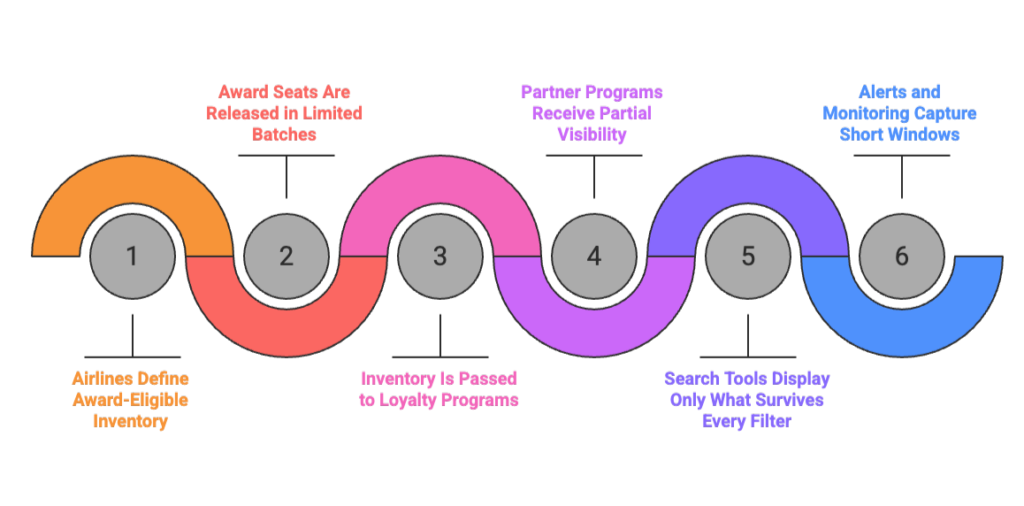
Step 1: Airlines Define Award-Eligible Inventory
Before flights are even searchable, airlines decide which seats are allowed into the award pool. This decision happens separately from cash pricing and seat maps. Most seats are excluded at this stage.
Here is what determines eligibility at this step:
- Cabin type and route profitability
- Expected paid demand on the route
- Corporate travel patterns
- Upgrade and operational buffer needs
Only seats cleared here can ever become award seats.
Step 2: Award Seats Are Released in Limited Batches
Eligible seats are not released all at once. Airlines release award inventory in small batches based on internal signals. These releases can open and close without notice.
Key release behaviors include:
- Initial release far in advance for select routes
- Additional releases after schedule changes
- Temporary releases when demand projections soften
If no release occurs, award seat availability remains zero.
Step 3: Inventory Is Passed to Loyalty Programs
Once released, award seats are sent to the airline’s loyalty program. This transfer does not include all eligible seats. Programs receive a filtered subset.
What happens at this stage:
- Loyalty programs apply their own booking rules
- Some seats are restricted to elite members
- Multi-passenger availability may be reduced
This explains why availability changes depending on who is searching.
Step 4: Partner Programs Receive Partial Visibility
Partner airlines do not see the same inventory as the operating carrier. They receive a smaller, delayed view. Many award seats never reach partners at all.
Common limitations here:
- Fewer seats shared with partners
- Delayed updates after inventory changes
- Priority given to the airline’s own members
This is where cross-program award availability becomes fragmented.
Step 5: Search Tools Display Only What Survives Every Filter
Search results reflect what remains after all earlier filters. If a seat is blocked at any step, it disappears from view. Searching harder does not change this.
What you see is affected by:
- Program-specific inventory access
- Passenger count in your search
- Timing relative to inventory refresh cycles
This is where award booking decision tools outperform manual searches.
Step 6: Alerts and Monitoring Capture Short Windows
Award seat availability can open briefly and close fast. Manual checks miss most of these windows. Monitoring systems catch them when conditions change.
Effective monitoring focuses on:
- Route-specific release patterns
- Program-level visibility shifts
- Multi-date and multi-route tracking
This is why award seat alerts improve outcomes more than repeated searches.
Summary Table: Where Award Seats Are Filtered Out
| Stage | What Happens | Why Seats Disappear |
| Eligibility | Airline pre-approves seats | Most seats excluded |
| Release | Inventory opened selectively | No release, no access |
| Loyalty program | Rules applied | Seats reduced |
| Partner sharing | Partial inventory shared | Visibility shrinks |
| Search results | Final filtered view | Availability looks empty |
Why Award Seat Availability Is So Limited for Premium Flights
Premium award seats are rare by design. Airlines do not treat business and first class as leftover inventory. You are competing for a tightly rationed resource that airlines release only when it supports their revenue goals.
Award seat availability in premium cabins is controlled as a business decision, not a system failure. Airlines balance loyalty liability against cash sales, upgrades, and corporate demand. Even when seats appear empty, they are often protected for higher-value outcomes later.
To understand the scale of constraint, consider this data point. An ANA analysis showed that 73% of successful long-haul business class award bookings required reservations at least nine months in advance, due to limited award inventory per flight. That scarcity is intentional. Using a premium award seat finder helps you spot those rare openings before inventory is pulled back.
Here is what limits premium award seat availability at a structural level:
- Airlines cap the number of award seats released per cabin, per flight
- Inventory decisions change dynamically based on demand signals
- Premium cabins are used to protect brand value and cash yield
- Loyalty redemptions are treated as deferred costs, not free seats
This is why searching harder does not solve the problem. The inventory often never enters the award pool.
Revenue Protection and Award Seat Availability Controls
Airlines manage award seat availability using a set of internal levers. You do not see these controls during a search, but they shape every result you get.
Below are the primary levers that restrict premium award space:
- Revenue forecasts: Flights with strong advance sales rarely release premium awards.
- Route profitability: High-margin routes protect business and first class inventory.
- Cabin demand patterns: Routes popular with paid premium travelers release fewer awards.
- Corporate contracts: Seats are reserved for last-minute business travel.
- Seasonal pricing pressure: Peak travel periods sharply reduce award releases.
Each lever prioritizes predictable cash over loyalty redemptions.
Why Premium Cabins Have the Worst Award Seat Availability
Business and first class seats carry higher financial risk for airlines. When you redeem points for these cabins, the airline absorbs a much larger liability than an economy award.
Two factors drive this imbalance:
- Higher liability per seat: A single premium award can represent several thousand dollars in forgone revenue.
- Brand signaling and exclusivity: Premium cabins signal scarcity, status, and consistency. Over-releasing awards weakens that perception.
This is why economy awards appear more often. The cost to the airline is lower, and the cabin is easier to fill without harming pricing power.
The next layer of friction appears once those seats pass through loyalty programs, where visibility and access narrow even further.
How Loyalty Programs Complicate Award Seat Availability
Loyalty programs do not create seats. They filter access to seats that airlines choose to release. When you search through a program, you are seeing a curated slice of inventory, not the full picture.
Airlines and loyalty programs operate as separate systems with different priorities. Inventory flows from the airline to the program under strict rules. That is why the same flight can show award seat availability in one program and none in another.
Key mechanics that cause this mismatch include:
- Airlines decide which seats are eligible for awards
- Loyalty programs receive limited access to that inventory
- Transfer partners see only what is shared with them
- Visibility timing varies by program and partner
This separation creates confusion, even for experienced points users.
Partner Airlines and Award Seat Availability Mismatches
Partner access is narrower than marketing suggests. When you book through a partner program, you rely on shared inventory, not the airline’s full award pool.
The main causes of partner mismatches are:
- Shared inventory limits: Only a subset of award seats is made available to partners.
- Delayed partner visibility: Seats may appear later or disappear earlier for partners.
- Preferred internal allocation: Airlines prioritize their own loyalty members first.
This is why tools that surface real, cross-program award seat availability matter. Manual searching across partners often misses seats that exist but are poorly exposed. Visibility improves when you use cross-program award availability instead of checking partners one by one.
Even when you understand airline and partner inventory rules, another layer still clouds the picture. That confusion deepens the moment you switch from loyalty programs to credit card portals, where award seat availability disappears entirely.
Why Credit Card Portals Distort Award Seat Availability
Credit card portals feel simple. You search, pick a flight, and pay with points. That convenience comes with a cost. Portals do not show award seat availability at all. They convert points into cash equivalents and book paid tickets behind the scenes.
This masks how award seat availability actually works. You are not accessing airline award inventory. You are buying a cash seat using points at a fixed rate. That distinction matters when premium cabins are involved.
Here is how portals distort the picture and increase point burn:
- Award inventory is bypassed entirely: Portals book revenue seats, even when award seats exist through airline programs.
- Point pricing is fixed, not optimized: Premium flights often cost two to four times more points than a true award redemption.
- No visibility into transfer opportunities: You do not see when transferring points could unlock better award seat availability.
- Scarcity feels absolute: When portals show high prices, it looks like seats are unavailable, not overpriced.
This creates silent overpayment. You spend more points without realizing a better option exists elsewhere. A proper points-to-flights optimization approach highlights when transfers beat portal pricing.
Tired of missing award seat availability the moment it opens?
Set FlightPoints Alertsto catch real inventory changes and act before premium seats are gone.
When portals blur the line between price and availability, bad assumptions start to take hold. That is where most myths about award seat availability begin.
Common Myths About Award Seat Availability
Bad advice spreads fast in points communities. These myths make award seat availability feel random when it is not.
Below are four ideas that cause most failed redemptions.
- Seats open if you search early enough: Early searches help, but airlines often release very few premium awards per flight. Many routes never open meaningful space at all.
- Airlines release leftover seats last minute: Last-minute premium awards are rare. Airlines protect these seats for paid upgrades and corporate travelers.
- All partners see the same inventory: Each partner sees a filtered version of award seat availability. What appears in one program may never appear in another.
- More points guarantee access: Points increase buying power, not inventory. If seats are not released, balance size changes nothing.
Understanding these limits saves time and false hope.
Once you strip away the myths, what remains is not chaos. It is timing and signal awareness, which determines whether you ever see award seat availability at all.
How Timing and Alerts Affect Award Seat Availability
Timing is not luck. It is probability management. Award seat availability changes in response to demand signals, not random releases.
Manual searches fail because humans cannot monitor shifting inventory at scale. Seats appear briefly and disappear just as fast. That is where alerts matter.
Here is how timing and alerts actually influence outcomes:
- Release windows are uneven: Some awards appear early, others surface after schedule changes or demand drops.
- Manual searches miss short-lived openings: Checking once a day or once a week skips most viable windows.
- Alerts capture signals, not guesses: Alerts notify you when award seat availability crosses defined conditions.
- Probability improves with flexibility: Multiple routes, dates, and programs increase exposure to openings.
If you did not use earlier stats, one fits here. A meaningful share of premium awards appear outside initial booking windows, often triggered by demand shifts rather than calendar rules.
Once timing and alerts become part of your approach, the remaining challenge is decision overload. That is where a clearer system is needed to turn signals into action.
How FlightPoints Helps Surface Real Award Seat Availability
After seeing how fragmented and constrained award seat availability is, the core problem becomes clear. You do not need more searches. You need better decisions with less noise.
FlightPoints acts as a decision filter. It sits between your points and airline programs to surface real award seat availability that is otherwise hard to detect. The goal is clarity during high-stakes planning.
Here is what FlightPoints focuses on:
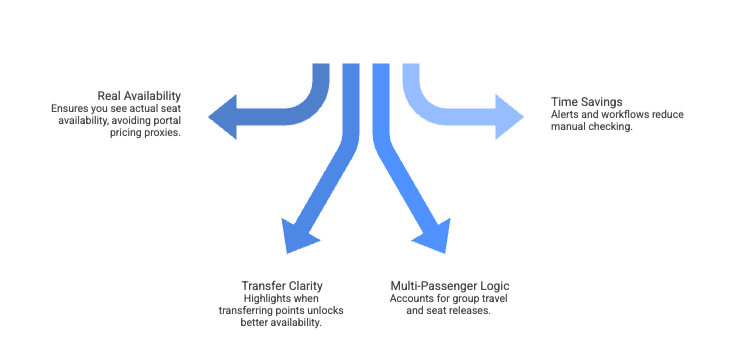
- Real availability detection: You see seats that actually exist across programs, not portal pricing proxies.
- Transfer path clarity: FlightPoints highlights when moving points unlocks better award seat availability.
- Multi-passenger logic: Family and group searches account for how many seats are released per flight.
- Time savings under pressure: Alerts and guided workflows reduce endless manual checking.
This directly addresses the frustrations discussed earlier. Instead of guessing where seats might appear, you see where action makes sense before inventory disappears.
Conclusion
Award seat availability feels frustrating because it is built to be scarce. Airlines control premium award inventory tightly to protect revenue, brand value, and future demand. When you miss a window, the real cost is not disappointment. It is the loss of a high-value experience that your points were meant to deliver. Every delayed search or mispriced booking increases opportunity cost, especially when premium seats are involved.
This is where FlightPoints comes to the play. Instead of forcing you to interpret fragmented data across programs and portals, FlightPoints brings clarity to award seat availability in moments that matter. You see real inventory, smarter transfer paths, and options that support multi-passenger bookings without endless trial and error. The result is faster decisions and fewer missed wins.
Still checking the same routes and hoping something changes? Ready to see real award seat availability before premium seats disappear? Sign up for FlightPoints and turn your points into confident premium bookings.


[…] Important distinction: A long advance purchase window does not guarantee the lowest fare or immediate award flight availability. […]
[…] context: Read what award seat availability means and why seats can disappear […]
[…] Award seat availability can change between your Flightpoints search and the final booking page. Mileage requirements and cash charges can also change without notice. […]
[…] bookings add another layer because award seat availability can differ between airline loyalty programs. Before booking, consider these […]
[…] Reality: A fuller understanding of award seat availability helps you distinguish missing inventory from a search […]
[…] empty Turkish Airlines award search does not tell you whether the aircraft is sold out. Your award seat inventory is the subset of seats released for mileage […]
[…] Saver-level award space often determines whether partner airline inventory reaches another loyalty program. For more context, read what affects award seat availability. […]
[…] maps: Do not use an empty-looking cabin map as proof of reward inventory. Read the award seat availability guide for the distinction between seat assignments and bookable […]
[…] and price the award seat first. Log in to Flying Blue or use a search tool to confirm the flight you want is bookable with miles right […]
[…] controls award inventory separately from cash sales. Check EVA Air award availability for your cabin and […]
[…] Also Read: What Is Award Seat Availability? (And Why It’s Hard to Find) […]