
If you have ever tried booking a flight with miles directly on the airline website, you’ve probably felt a little frustrated. You search your route. No availability. You change dates. Still nothing. You try another airline. The price is sky high. Now you start wondering whether award travel is even worth it.
But here’s the reality: airline websites are not designed to make award searches easy. They are designed to sell and prioritize cash tickets first. Award booking engines are layered on top of revenue systems, and that structure creates limitations in visibility, flexibility, and comparison.
The good news here is that you do not need to rely on airline websites alone to find award flights. In fact, serious award travellers rarely do that.
This guide will show you exactly how to find and book award flights without airline websites as your primary search tool.
Firstly, let’s focus on understanding why airline sites fall short and how award search tools like Flightpoints change the game.
Quick Summary
- Award flights can be found without using airline websites with award search tools.
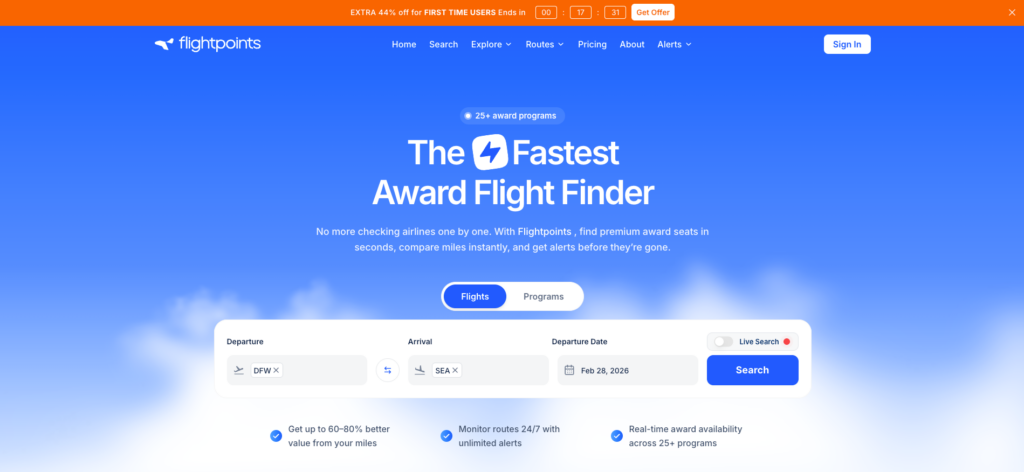
- Platforms like Flightpoints allow travelers to search availability across multiple airlines in one place.
- Understanding airline alliances helps you find partner airline flights that do not appear on an airline website.
- Expanding your search to include nearby airports and connecting flights increases the chances of finding available award seats.
- Flexible travel dates are important because award availability varies significantly depending on the day and route.
- Searching segment-by-segment can reveal hidden award seats that do not appear in full route searches.
- Combining multiple search methods makes finding award flights faster and efficient.
Why Airline Websites Make Award Searching Difficult
As you should know by now, the truth is that airlines prioritize revenue and revenue only. When you open an airline’s website and search for flights, the system’s primary goal is to sell you a cash ticket. Award searches are integrated to the same engine, which means:
- Award results may be filtered behind revenue logic
- Partner flights may not display consistently
- Calendar views are often limited
- Mixed-cabin options are confusing
- Multi-city searches can break easily
Even worse, you can only search one loyalty program at a time. If you have transferable credit card points, this means opening multiple airline sites, entering the same route repeatedly, and manually comparing prices.
That process is slow. And more importantly, it limits visibility.
When directly searching on airline websites, you’re essentially looking through a narrow window instead of seeing the entire landscape of award options.
What It Actually Means to “Find Award Flights”
Before we talk about tools, let’s clarify something important. Finding an award flight does not simply mean seeing a flight that can be booked with miles. It means identifying:
- Availability that can actually be ticketed
- The lowest mileage option across programs
- A routing that works logically
- A price that reflect strong redemption value
Airline websites only show their own inventory first. This can hide better options available through partners or alternative programs.
When you move from airline websites, you shift from a single-program view to a multi-program view. That shift alone dramatically increases your chances of success.
How Award Search Tools Help in Finding Award Flights
An award search tool aggregates availability across multiple loyalty programs and presents it in one interface. Instead of searching airline by airline, you enter your route once and review options across programs. One such platform is Flightpoints.
Let’s look at the structural difference between an award search tool and an airline website:
Feature | Airline Website | Award Search Tool |
| Searches multiple programs at once | No | Yes |
| Designed specifically for award travel | No | Yes |
| Easy comparison across loyalty programs | No | Yes |
| Flexible date scanning | Limited | Expanded |
| Time required per route | High | Low |
This highlights the core of search tools: visibility and efficiency. However, simply having access to a tool does not guarantee success. The strategy behind how you search matters just as much as the platform itself.
How to Use an Award Search Tool Properly
Most beginners make mistakes by treating an award search tool like an airline website. They search once, glance at the result, and move on. This approach wastes the tool’s full potential. Let’s walk through how to use it strategically.
Step 1: Always Search One Way First
Round-trip searches can hide availability. If only one route has saver space, a round-trip query may return no results at all. Instead:
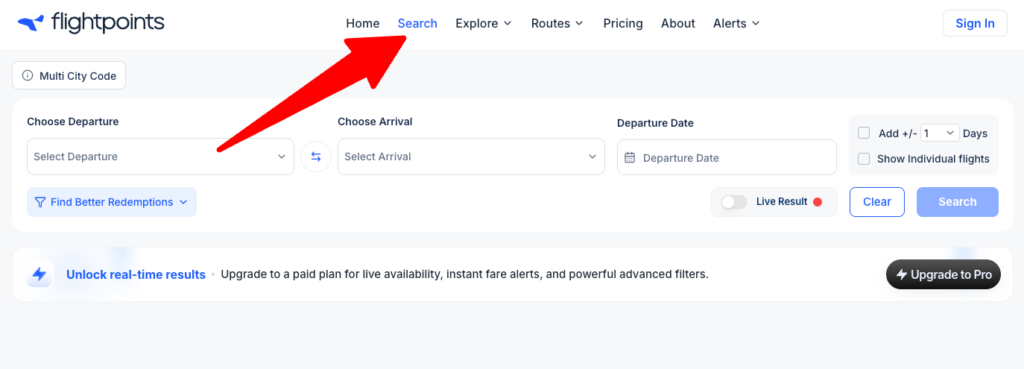
- Search outbound separately
- Search return separately
- Compare options individually
These techniques immediately double your visibility.
Step 2: Use Flexible Dates Intelligently
Award availability is rarely consistent day-to-day. Searching for a single date narrows your results unnecessarily. Instead, use flexible date ranges to identify patterns.
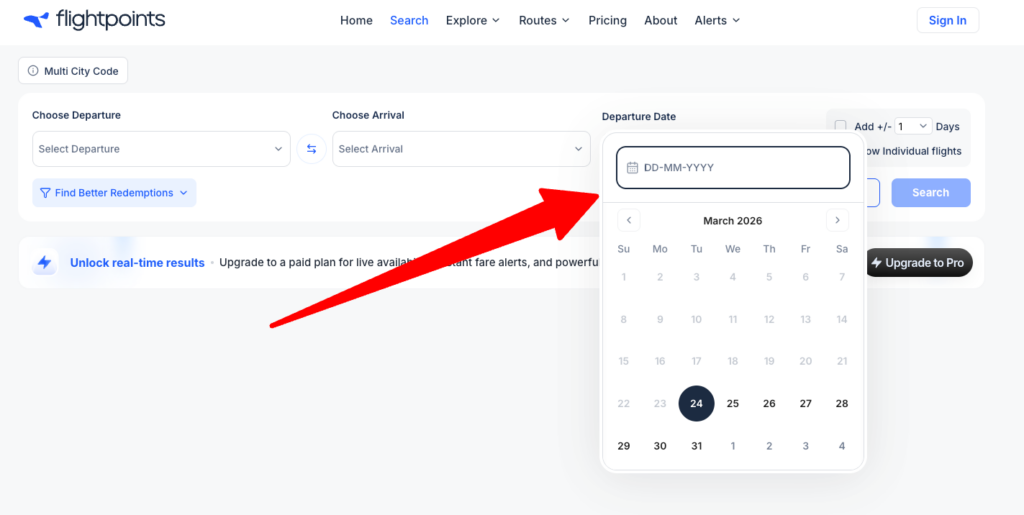
For example, a flight on Monday might show 95,000 business miles and the next day it might become 60,000 business miles.
Without flexible search, you would only see one price and assume that is standard. Flexible scanning reveals the lower pricing days instantly. This alone is one of the biggest advantages of using an award search tool instead of an airline website.
Step 3: Start Searching With Major Hubs
Make sure to search from major airports. If you search only from your home airport, you are limiting availability. Instead:
- Search from major gateway cities
- Identify long-haul availability first
- Add domestic connections later
For example, instead of searching Small City to Tokyo, search:
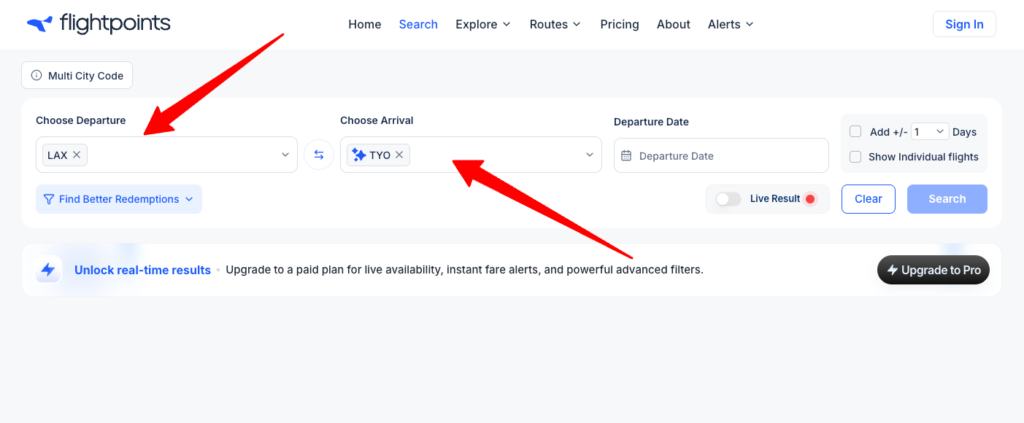
Los Angeles to Tokyo, New York to Tokyo, or Chicago to Tokyo. Once you identify a long-haul award space, you can build around it.
Step 4: Break Routes Into Segments
Sometimes airline systems fail to display itineraries that technically exist. For example, instead of searching Dallas to Rome, search Dallas-New York-Rome. Break your routes into segments to streamline search availability.
Award search tools allow you to analyze availability by segment. If both segments exist individually, you can often combine them. This bypasses routing limitations.
Step 5: Compare Programs Before Transferring Points
This is a very important pro tip. If you earn points through transferable currencies, you should never transfer blindly. Without a centralized comparison, you would have to search each program separately. That increases the risk of transferring to a higher-cost option.
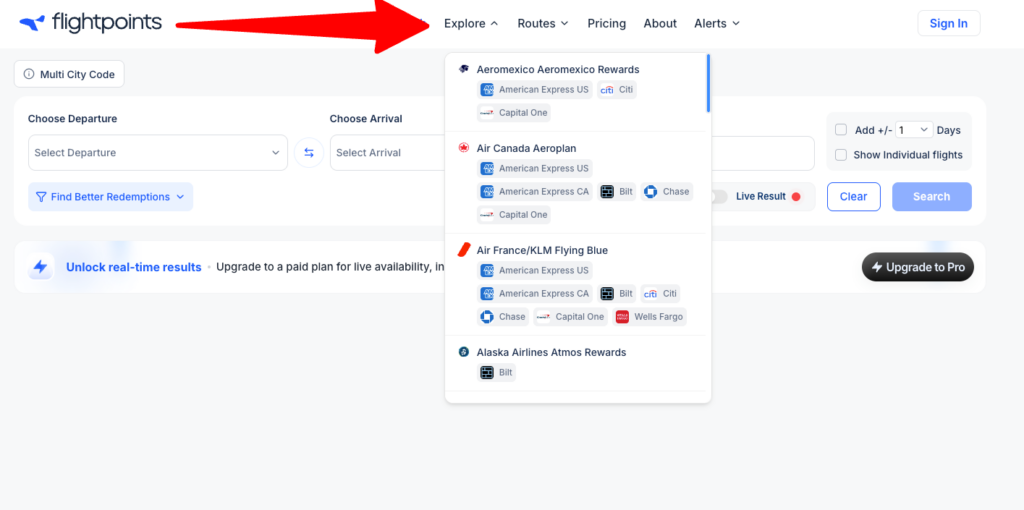
This is again where award search tools like Flightpoints help you compare multiple programs with real-time availability.
Use the explore feature in Flightpoints to compare multiple programs in a single interface.
Strategic Search For Award Travel
Award searching is not about luck. It is also about structure. When people say there are no award seats available, they actually mean:
“There are no award seats on the specific date, from my specific airport, to my specific route that I initially searched.
In such cases, Flightpoints allow you to expand:
- Date range
- The origin airport
- Destination flexibility
- Cabin combinations
- Program comparisons
The more flexible your search parameters are, the more options appear. Airline websites restrict this flexibility, and award search tools enable it.
Even when you use a tool, airline websites still play a role at the final booking stage. You use the tool to identify availability and compare programs. Booking takes place in the respective airlines itself.
Advanced Methods And Techniques To Find Award Flights
After understanding the basics of award search tools, the next step is learning how to identify opportunities that airline websites often hide or fail to display properly. Many frequent travelers rely on alternative strategies because booking engines often miss partner availability or limit how results are displayed.
So now, let’s focus on advanced techniques that help travelers locate award flights even when airline websites are not used as the primary search method.
- Using Alliance Availability Patterns
Airline alliances share award inventory across partner airlines. However, not every airline displays all partner flights clearly on its own website. This is why understanding alliance availability patterns can help you identify routes without relying on airline booking engines.
The three major alliances in global aviation operate extensive partner networks.
| Alliance | Major Airlines | Global Coverage |
| Star Alliance | Lufthansa, Singapore Airlines, ANA, United | Largest global network |
| Oneworld | Qatar Airways, British Airways, Cathay Pacific | Strong long-haul coverage |
| SkyTeam | Air France, KLM, Korean Air | Strong Europe-Asia routes |
Instead of checking airline websites individually, use an efficient award search tool like Flightpoints to check alliance-wide availability in a single search. This approach allows you to identify multiple partner airlines that operate the same route.
For instance, a route between two cities might be served by several alliance partners. Even if one airline has no award seats available, another partner airline may release seats on the same route. This strategy increases the chances of finding award availability.
- Segment-by-Segment Search
As discussed before in this guide, one of the most effective techniques for finding hidden award availability is segment-based searching. Airline websites often fail to show itineraries that involve connections. When searching through an award search tool, breaking the trip into individual flight segments can reveal availability that would otherwise remain hidden.
For example: A long itinerary such as, New York-Doha-Malé may not appear as a single award search result. However, searching the segments separately might reveal availability.
But when you search the same as segments:
- New York-Doha: Possible result is “award seat available”
- Doha-Malé: Possible result is “award seat available”
Once both segments are identified, they can often be combined into a single award booking.
Segment searching is widely used by experienced award travelers because it uncovers seats that automated airline searches fail to show.
- Searching Nearby Airports
Another powerful technique when searching is expanding your search to nearby airports. Award availability is limited and varies significantly between airports in the same region. A nearby city may have significantly better award space.
| Primary Airport | Alternative Airport |
| London Heathrow | London Gatwick |
| Tokyo Narita | Tokyo Haneda |
| New York JFK | Newark |
Flightpoints allow travelers to check multiple airports quickly. This makes it easier to identify alternative departure or arrival options. Using nearby airports can improve your chances of finding premium cabin award seats.
- Flexible Date Searching
Award availability changes daily. Some days may have no available seats while other days offer multiple award options. Instead of searching for a single date, experienced travelers use flexible date searches.
| Search Method | Benefit |
| Single date search | Limited results |
| Flexible date search | Wider availability |
An award search tool like Flightpoints allows travelers to check multiple dates simultaneously, which makes it easier to identify the days when airlines release award inventory.
Flexible searching is particularly useful for long-haul routes where award seats may only appear on certain days of the week.
- Monitoring Award Availability
Award seats can appear and disappear frequently as airlines adjust inventory. This means a flight that has no award seats today might suddenly become available later.
Instead of repeatedly checking airline websites, set alerts on Flightpoints to get notified whenever there is an availability or price drop on your desired routes.
- Understanding Airline Release Patterns
Airlines release award seats at different times depending on their internal inventory systems. Knowing these patterns helps travelers search more effectively without relying on airline websites.
| Airline Type | Typical Release Pattern |
| Full-service carriers | Seats released when schedule opens |
| Some airlines | Last-minute availability |
| Premium airlines | Limited saver inventory |
Flightpoints, the fastest award flight finder, makes it easier to detect these patterns by scanning multiple airlines simultaneously. Understanding these patterns also helps travelers time their searches strategically.
- Checking Multiple Cabin Classes
Many travelers search only for economy class award seats, but availability often varies across cabin classes. Sometimes business class seats may appear even when economy awards are unavailable. Checking multiple cabin classes increases the chances of finding a redeemable award seat.
| Cabin | Availability Trend |
| Economy | Most common, but competitive |
| Business | Limited but valuable |
| First Class | Very limited |
- Combining Multiple Award Programs
Award flights do not always need to be booked through a single airline program. Many routes can be booked through multiple partner programs. This flexibility allows travelers to choose the program that provides the best availability.
| Program Type | Advantage |
| Airline loyalty programs | Direct redemption |
| Partner airline programs | Alternative availability |
| Bank travel portals | Additional redemption options |
An award search tool helps identify which program has access to the same flight inventory.
- Using Bank Travel Portals
You can also book award flights through your credit card’s travel portals. Bank reward programs provide a way to access award flights without visiting airline websites.
Bank travel portals are especially useful when airline award seats are unavailable but revenue seats can still be booked with points.
| Portal Feature | Benefit |
| Multi-airline search | Wider coverage |
| Point redemption | Flexible payment |
| Simplified booking | No airline account required |
Common Mistakes To Avoid When Searching For Award Flights
Even with the right tools and strategies, many travelers struggle to find good award flights because of a few common mistakes. Avoiding these errors can significantly improve your chances of finding available seats.
- Searching only direct flights.
- Not checking partner airlines.
- Using rigid dates.
- Ignoring nearby airports.
- Searching only once.
- Assuming empty seats mean award seats.
- Booking too late for popular routes.
Conclusion
Finding award flights without relying on airline websites may seem complicated at first, but the process is actually much easier than you might expect. Mainly, Award search tools provide multiple ways to discover award seats without manually searching every airline website.
Use Flightpoints and expand your search across partner airlines and apply the search techniques we learned. Such as flexible dates and segment-by-segment searches. Uncover many award opportunities that traditional airline searches might miss.
With the right approach and consistent searching, award travel becomes much more accessible and efficient.
FAQs
Q: Why don’t airline websites show all available award flights?
Many airline websites only display flights from their own program or limited partner airlines. Some partner award seats may not appear in those search results.
Q: What is the easiest way to find award flights across multiple airlines?
Using an award search tool like Flightpoints allows you to search across multiple airlines and alliances in one place instead of checking each airline separately.
Q: Do award seats appear at the same time for every airline?
No. Airlines release award seats at different times depending on demand, inventory, and route performance.
Q: Is it better to search with flexible dates when looking for award flights?
Yes. Award availability can vary greatly by date, so flexible searches increase the chances of finding available seats.
Q: Can bank travel portals be used to book award flights?
Yes. Some bank travel portals allow you to redeem points for flights without needing to search directly on airline websites.
Q: Why do some award flights require connections instead of nonstop routes?
Airlines often release more award availability on connecting routes than on direct flights, especially for long-haul travel.
Q: How often should you check for award availability?
Award availability can change frequently, so checking periodically over several days or weeks can improve your chances of finding seats.