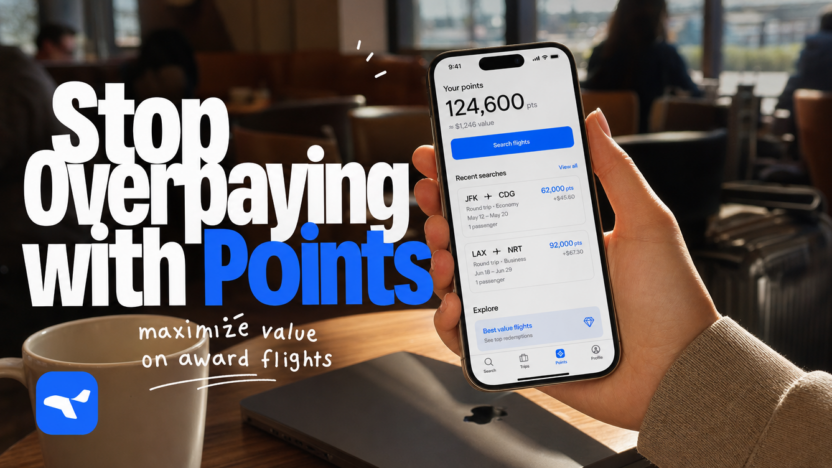
From long-haul business class seats to last-minute international flights, airline miles and credit card points can unlock incredible travel experiences. But many travellers unknowingly overpay with points, settling for poor-value redemptions that could be far more worthwhile.

Overpaying is one of the most common mistakes in award travel. It doesn’t just mean using points than necessary, it also includes missing better redemption opportunities, choosing inefficient booking methods, or redeeming points at a low value through the wrong platform.
This guide explains how to avoid overpaying with points and focus on strategies used by experienced award travelers to ensure every redemption delivers maximum value.
Never Miss a Points Drop

Get notified the moment award prices drop so you can book before they’re gone.


Quick Summary
- Compare multiple airline programs before booking, the same flight can cost very different points.
- Focus on high-value redemptions by calculating cents per point (CPP).
- Avoid travel portals and transfer points to airline partners for better value.
- Use partner airline bookings to reduce mileage costs.
- Book one-way tickets to maximize flexibility and savings.
- Watch for transfer bonuses to lower the number of points needed.
- Always consider both points and fees before booking.
- Use tools like Flightpoints to quickly find the best-value options.
How To Avoid Overpaying With Points: What It Really Means
It is kind of hard to understand whether you are overpaying because unlike cash, points don’t have a fixed value. Overpaying typically happens in three ways:
- Using more points than necessary for the same flight.
- Redeeming points for low-value options like portals and poor flight deals.
- Ignoring better partners or transfer opportunities.
For example, let’s say you look up for an award ticket directly through an airline website. Here, with dynamic pricing it might cost you 250,000 points, while the exact same seat could be booked via a partner program for 70,000 points.
The key to avoid overpaying with points is understanding how to measure value. Let’s take a look into that.
How To Calculate Cents Per Point (CCP)
Cents per point (CCP) is the most important concept in determining whether a redemption is worth it. It measures the value you get from each point or mile redeemed on award travel.
CCP prevents overpaying by comparing redemption value to cash prices, helping you skip low-value deals when sweet spots exist.
For example if,
Cash ticket price = $1,200
Taxes paid = $150
Points used = 60,000
This means each point gives you 1.75 cents in value.
What Counts as a Good Redemption?
| Redemption Type | Good Value |
| Economy Flights | 1.2 – 1.5 CPP |
| Flexible Points | 1.5 – 2.0 CPP |
| Business Class | 2.0 – 4.0 CPP |
| First Class | 4.0+ CPP |
Pro Tip: If 10,000 points are not saving you at least $100-$150, you are likely over paying.
How Travel Portals Increase Overpaying and Reduce Redemption Value
One of the most common ways travelers end up overpaying with points is by booking through credit card travel portals. Travel portals often fix the point value at around 1 cent per point. It could also go higher depending on the card.
The typical value while booking through travel portals is 1.0 CPP. But a typical CPP of airline transfer partners is around 2.0 – 10.0.
Better Strategy Instead of Using Portals:
- Transfer points to airline partners
- Book through programs
- Compare points using tools like Flightpoints
This change can double or even triple your redemption value.
Always Compare Programs To Maximize Value of Points
Again, one of the biggest mistakes is booking through the first program you check. Keep this in mind: “different programs price the same flight differently”.
This happens because each airline loyalty program uses its own pricing system. Some use dynamic pricing based on demand, while others follow fixed award charts. As a result, the same seat on the same flight can have drastically different point costs depending on which program you use.
How To Avoid This?
Many travelers miss valuable opportunities because they limit their search only to programs they are familiar with. However if you are a Flightpoints user, you don’t need to worry about making this mistake. At Flightpoints you can easily filter your search according to your needs and it will give you all the real-time options.
Using an award search tool like Flightpoints will change the whole award travel experience. No manual searches, no manual comparisons, no confusions, no outdated updates.
- Compare multiple programs instantly
- Identify cheapest redemption
- Avoid overpriced bookings
Leverage Partner Airline Bookings
Now this is an important part. Booking through partner airlines is one of the most powerful strategies in award travel. Instead of redeeming points directly with the airline operating the flight, you can use a partner program within the same alliance to book that exact seat at a lower cost.
By understanding how alliances work, you gain access to a much wider network of flights and pricing options, which helps you avoid overpaying.
| Alliance | Major Airlines |
| Star Alliance | United, Lufthansa, Singapore Airlines |
| Oneworld | American Airlines, Qatar Airways |
| SkyTeam | Delta, Air France, KLM |
Why Partner Bookings are Better
- Lower mileage requirements
Partner programs often charge fewer miles for the same flight because they follow different pricing structures. This can result in massive savings, especially for long-haul or premium cabin flights.
- Fixed award charts
Many partner programs still use fixed pricing instead of dynamic pricing. This means the number of miles required remains consistent, allowing you to avoid sudden price spikes during peak demand.
- Better availability in some cases
Certain award seats may not appear when searching directly through an airline but become available through partner programs. This expands your travel options and increases the chances of finding a seat. You can filter your search on Flightpoints with partner programs and check real-time award availability.
Book One-Way Tickets Instead of Round Trips
Many travelers default search round trip bookings because that feels simpler, but this approach can limit flexibility and often lead to higher point costs. Award pricing is not always consistent across both directions of a journey. One could be cheap and the other could be extra expensive.
When you book round trips, you are forced to accept the combined pricing of a single program, even if one segment is overpriced. However, booking one-way tickets allows you to evaluate each leg separately and choose the most efficient one.
Benefits of One-Way Bookings
- Mix different airlines
One-way bookings lets you combine different airlines or alliances for each segment of your trip. This is especially beneficial when one airline has better availability and cost in one direction but not the other.
- Choose cheapest program
Each route will be priced differently across programs, so splitting your journey lets you book each segment using the program that offers the lowest point requirement. This can significantly reduce the total cost of points.
- Avoid being locked into one airline
Round-trips often force you to stick onto one airline or loyalty program even when better options exist. One-way bookings remove this restriction and give you full control over your itinerary.
How Transfer Bonuses Help You Avoid Overpaying With Points
Credit card programs frequently offer transfer bonuses to airline partners, which can significantly improve the value of your points. These promotions give you extra miles when you transfer points, meaning you effectively need fewer points for the same redemption.
Many travelers overlook this and transfer points immediately and miss opportunities worth more value. By timing your transfers with these bonuses, you can stretch your points further and reduce the overall cost of flights, especially when partner redemptions are already high.
For example:
| Transfer Bonus | Effect |
| 30% bonus | 50,000 – 65,000 miles |
Here, transferring 50,000 points gives you 65,000 miles, which can be the difference between affording a flight or not. It effectively reduces the real cost of redemption.
Why This Matters
- Reduces effective cost of flights
Transfer bonuses lower the number of points you originally require. Like in the example shown above, a flight that normally requires 65,000 miles would only require 50,000 points during a 30% bonus. This saves a significant amount
- Increases CPP Value
Because you are getting more miles for the same number of points, the value per point increases. This means that the redemption delivers better returns.
- Unlocks better redemptions
Some premium cabin flights may seem out of reach at standard rates, but transfer bonuses can make them accessible. This lets you book higher value flights without extra points.
Strategies to Achieve Transfer Bonus
- Wait for bonus before transferring
Avoid transferring points unless necessary. Monitoring transfer bonuses actually helps in maximizing point value. (especially for non-urgent travel plans)
- Combine with partner bookings
You get the best out of transfer bonuses when you combine them with partners which may already be low-cost redemptions.
- Use tools to identify programs first
Before transferring, use tools like Flightpoints to identify which program offers the best redemption. If you want, you can also wait for a bonus to maximize value even further.
Beware of High Fees and Surcharges
As you might already know by now, points booking is not completely free. Some airlines add significant fuel charges and additional fees on award tickets. These charges widely vary depending on the airline and program. Sometimes, this cash component can be so high that it reduces the overall value of your redemption.
Many travelers focus only on the number of points required and overlook these extra costs, which leads to overpaying in total value. To maximize your redemption, it is important to evaluate both points and fees together rather than looking at points alone.
With Flightpoints you wouldn’t have to worry about this. All the extra charges are displayed along with the points.
Take this example:
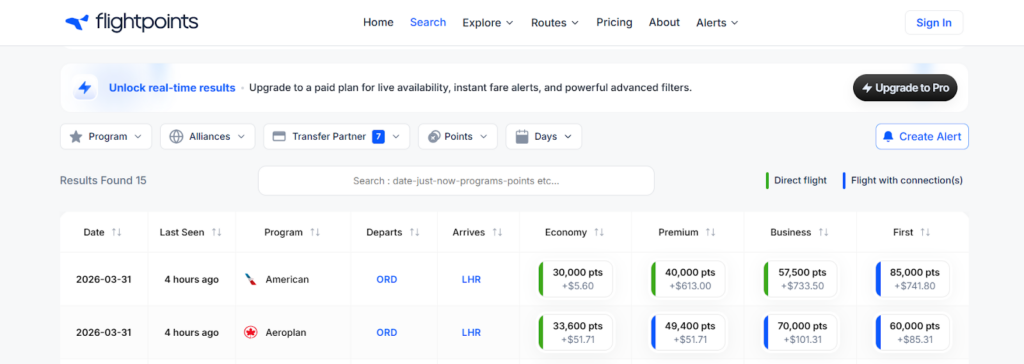
American Airlines first class: 85,000 points+$741.80
Same route and class with Aeroplan: 60,000 points+$85.31
When To Pay Cash Instead of Points to Avoid Low-Value Redemptions
In some situations, the cash price of the ticket will be low enough that redeeming points would give you very poor value. Here, using points wouldn’t be the best option even when you have a large balance. Since points are a limited resource, using them inefficiently on cheap flights can prevent you from using it for higher value redemptions.
The goal is not to use points for every booking, but to use them where they offer the most value. Knowing when to pay with cash is just as important as knowing when to redeem points.
Situations Where Cash Is Better
- Cheap economy fares
When airlines offer discounted fares, the cost in cash can be very low compared to the number of points required. In such cases, using points often results in low CPP value.
- Short-haul flights
Short-distance routes usually have lower cash prices but still may require a small amount of points. This mismatch often leads to poor value when redeeming points.
- Low CPP redemptions
If the value you calculated falls below the normal range (typically under 1-1.2 CPP), it is usually better to pay in cash and save your points for better opportunities.
Advanced Strategies To Maximize Value
Maximizing the value of your points requires going beyond basic redemption strategies. Experienced travelers use advanced techniques to reduce points cost and increase flexibility. Though they require more planning, the savings and improved value can be significant.
Understanding and applying these methods can help you consistently avoid overpaying.
- Combine multiple programs
Benefits of combining and comparing programs have been explained in the above sections. But again, using a single loyalty program for an entire trip can limit your options and lead to higher costs. Combining multiple programs and dividing the trip into segments makes way for high redemption values.
It also increases the chances of finding award seats, especially for long-haul routes.
- Use stopovers
Some loyalty programs allow stopovers, which let you visit an additional city on the same ticket without requiring any extra points. This increases the value of your points by giving two destinations for the price of one. When used strategically, stopovers can increase both redemption value and travel experience.
If you want to know more about stopovers in award travel, read this: What Is a Stopover In Award Travel.
- Rebook when prices drop
Award availability and pricing can change frequently, especially in programs with dynamic pricing. If you find a cheaper redemption after booking, many programs allow you to cancel and rebook for a lower point cost. If you find it worthwhile, go for it and increase your overall point value.

Award Travel Grader
See how top loyalty programs like Delta SkyMiles, United MileagePlus, and Chase optimize your travel rewards.
- Track Availability with unlimited alerts
- Save Thousands of miles per trip
- Real-time Award Availability
How Flightpoints Help in Maximizing Point Value
Using an award search tool like Flightpoints simplifies award booking decisions by allowing you to compare multiple programs in one place. You can quickly identify the best redemption options based on points and fees.
This reduces the time and effort required to find efficient bookings and helps prevent costly mistakes. For travelers who want to avoid overpaying, using a comparison tool is almost essential.
Key Benefits
- Compare programs instantly
FlightPoints aggregates results from multiple loyalty programs, allowing you to see different pricing options at once instead of searching individually. - Identify best value redemptions
By comparing point costs and fees, you can quickly determine which program offers the best overall value for your flight. - Avoid overpriced bookings
The tool helps highlight when a program is charging significantly more points than alternatives, allowing you to avoid poor-value redemptions. - Save time
Instead of spending hours researching different options, you can make faster and more informed decisions.
Common Mistakes That Lead To Overpaying
- Not calculating CPP
- Using travel portal to book award flights
- Ignoring partner programs
- Booking without exploring multiple options
- Holding points for too long


Unlock Pro Travel Intelligence
Search every airline, track award space in real time, and discover hidden flight deals before they’re gone.
Conclusion
Avoiding overpaying with points is not only about using fewer points, it is about using them strategically. Travelers who understand valuation, compare programs, and leverage partner bookings can unlock significantly more value from the same number of points.
Points are a powerful currency, but only when used correctly. By following these strategies, you can consistently avoid overpaying with points and maximize your redemption value.
FAQs
Q: How do I know if I am overpaying with points?
You can determine this by calculating the cents per point (CPP) value of your redemption. If the value is below roughly 1–1.2 cents per point for economy or 2+ cents for premium cabins, you are likely overpaying.
Q: Why do different airlines charge different points for the same flight?
Each loyalty program uses its own pricing system. Some use dynamic pricing, while others follow fixed award charts. Partner airline agreements also affect pricing, which is why the same flight can cost significantly fewer points when booked through a different program.
Q: What is the best way to maximize the value of my points?
The best way is to combine multiple strategies: calculate CPP, compare programs, use partner airline bookings, and take advantage of transfer bonuses. Using award search tools is also an efficient way to maximise value.
Q: Do transfer bonuses always guarantee better value?
Not necessarily. Transfer bonuses increase the number of miles you receive, but the underlying redemption still needs to be valuable. If the flight itself is overpriced in miles, a transfer bonus will not automatically make it a good deal. Always evaluate the final redemption value before transferring points.


[…] through a retail portal without comparing the cash price of the same […]
[…] Also Read: How To Avoid Overpaying With Points: A Practical Guide […]
[…] mistake: Travelers often assume a mixed cabin award always costs less than two separate tickets. In practice, pricing depends on the program, the route, and the mileage […]
[…] Overpaying relative to cash price: Redeeming a large number of points for a seat that was only moderately more expensive in cash. […]