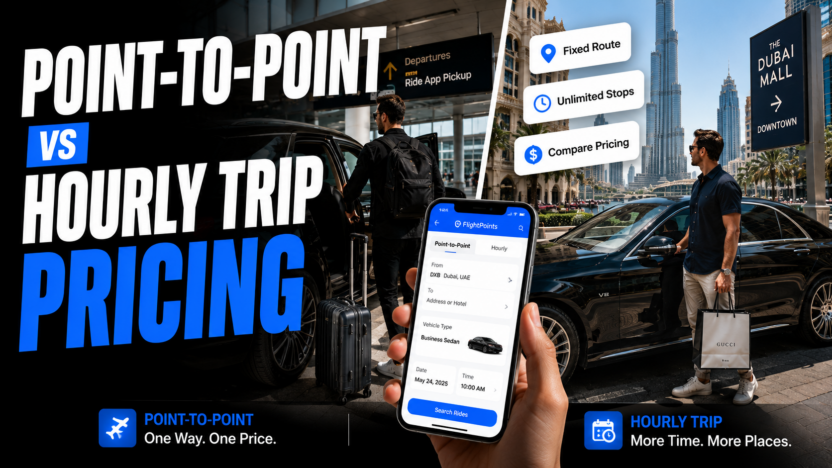
Premium travel costs in 2026 do not behave the way they did five years ago. Award seats shift in price daily, algorithms reprice routes by the hour, and the same business class cabin can cost 60,000 points one morning and 180,000 the next. A clear point-to-point vs hourly trip pricing comparison helps frequent flyers cut through the volatility and book with confidence.
Point-to-point travel pricing locks a fixed cost to a defined route. Hourly trip pricing flexes with demand, time of day, and seat availability. Knowing when each model wins saves real money. This guide breaks down both structures, shows where each delivers value, and explains how a sharp point-to-point vs hourly trip pricing comparison protects your points balance through 2026.
Quick Summary
- How point-to-point travel pricing differs from hourly trip pricing in 2026
- A side-by-side cost, flexibility, and predictability breakdown
- Where dynamic award pricing trips up frequent flyers
- 2026 sweet spots that still use fixed award charts
- How the premium travel cost comparison really works for business class
- The faster way to spot real award seat availability before it disappears
Understanding Modern Travel Pricing Structures
Two pricing models dominate premium travel today. One uses fixed costs tied to a specific route. The other treats every seat as a moving target priced by demand. The difference shapes every redemption decision you make.
What Is Point-to-Point Travel Pricing?
Point-to-point travel pricing assigns a fixed cost to a defined origin and destination. The route price stays predictable regardless of search date or current demand. Most published award charts still use this model, especially on partner bookings.
Air Canada Aeroplan, Alaska Mileage Plan, ANA Mileage Club, and Singapore KrisFlyer all published point-to-point award charts in 2026. Travelers see the cost up front. No surprise surges based on the booking hour.
What Is Hourly Trip Pricing?
Hourly trip pricing flexes the cost based on time, demand, and inventory. The same seat can cost different amounts within a single day. Major US carriers, including Delta SkyMiles, United MileagePlus, and American AAdvantage, run dynamic award models that behave this way on self-operated flights.
This model rewards flexible travelers who can shop multiple dates. It punishes anyone locked into a specific departure window.
Point-to-Point vs Hourly Trip Pricing Comparison: Cost, Flexibility, and Value
A direct point-to-point vs hourly trip pricing comparison shows clear tradeoffs. Each model wins under different conditions. The right choice depends on your travel style and how flexible your dates are.
Side-by-Side Pricing Breakdown
| Factor | Point-to-Point Travel Pricing | Hourly Trip Pricing |
| Cost Predictability | High. Fixed cost per route | Low. Cost shifts hourly |
| Best For | Locked dates, fixed routes | Flexible travelers, off-peak flying |
| Award Chart | Published, transparent | Algorithmic, hidden |
| Sweet Spot Potential | Strong, especially on partners | Rare. Surges common |
| Risk | Limited inventory release | Phantom availability, price jumps |
| Typical Programs (2026) | Aeroplan, Alaska, ANA, Singapore | Delta, United, American, JetBlue |
Quick note: Run a premium travel cost comparison before every booking. Even fixed charts can shift with fuel surcharges.
Flexibility vs Fixed Route Efficiency
Point-to-point travel pricing protects you from surge cycles. The cost holds steady whether you book six months out or two weeks before takeoff.
Hourly trip pricing rewards patience. Watch a route for a week, and the same business class seat can drop 30 to 50 percent. The opposite also happens, fast.
Hidden Costs Travelers Often Miss
Both models carry costs that a surface-level premium travel cost comparison hides. Watch for:
- Fuel surcharges on partner award redemptions are often 200 to 800 dollars per ticket
- Mixed-cabin itineraries priced as full business class
- Phantom availability from cached search results
- Last-seat upcharges on dynamic award programs
How Premium Travelers Build a Smart Award Flight Pricing Strategy
A working award flight pricing strategy in 2026 starts with knowing which model controls each leg of your trip. Many premium itineraries use both. The outbound may be priced as point-to-point on a partner. The return may shift hourly on the operating carrier.
Direct Flight Pricing Comparison
Non-stop flights almost always cost more in cash. A direct flight pricing comparison usually shows a 30 to 60 percent premium over a one-stop alternative on the same date.
The math improves with award seats. Most fixed award charts charge the same price for direct or connecting routes within the same zone. That makes point-to-point travel pricing far more efficient on long-haul business class.
Dynamic Pricing and Demand-Based Fare Changes
Demand drives hourly award costs more than fuel or operating expenses. Holiday weeks, conference dates, and school breaks all trigger surges. Airline loyalty pricing trends in 2026 show award costs jumping 40 to 100 percent in peak weeks on dynamic programs.
Tool tip: The Flightpoints CPP Calculator confirms whether a redemption clears 1.5 cents per point before you transfer.
Also Read: Fixed vs Dynamic Award Pricing: How Award Costs Really Work
2026 Sweet Spots Where Point-to-Point Pricing Still Wins
Despite the dynamic shift, fixed award charts still deliver outsized value on the right routes. These sweet spots reward travelers who plan around the chart.
- Aeroplan US to Europe in business class: 60,000 to 70,000 points one-way on Star Alliance partners
- Alaska Mileage Plan to Asia on Japan Airlines business: strong fixed-chart value on transpacific routes
- ANA Mileage Club US to Europe round-trip in business: 88,000 to 110,000 points, depending on season
- Singapore KrisFlyer Saver awards: premium economy and business class on Singapore Airlines
- Flying Blue Promo Awards: rotating monthly discounts up to 50 percent off standard rates
These figures track published 2026 rates and exclude taxes plus carrier surcharges. Verify before transferring points, because partner chart adjustments roll out without long notice.
Also Read: What Is a Sweet Spot in Award Travel
Why Business Class Award Availability Is Still the Hardest Find
Even at sweet-spot pricing, business class award availability stays tight. Carriers release seats in waves. Most premium cabin inventory opens at scheduled launch, roughly 330 to 355 days out, then again inside the 14-day window.
The travelers who consistently book these seats share one habit. They check often, or they automate the checking.
Which Point-to-Point vs Hourly Trip Pricing Comparison Wins for You?
The right pricing model depends entirely on your trip profile. Use these rules to decide quickly.
When Point-to-Point Travel Pricing Wins
- You have fixed dates and a fixed route
- You want a guaranteed cost upfront
- You are redeeming on a partner airline
- You are booking long-haul premium cabins
When Hourly Trip Pricing Wins
- Your dates flex by a week or more
- You can fly off-peak (mid-week, late evening)
- You are watching for promotional drops
- You are domestic-only and short-haul
The Quick Verdict:
Frequent flyers in 2026 should default to point-to-point travel pricing for international premium cabins. Switch to hourly trip pricing tracking for short-haul, flexible, or last-minute trips. Mixing both inside one itinerary is fine. Most sharp travelers already do.
How Flightpoints Helps You Win the Pricing Comparison
A useful point-to-point vs hourly trip pricing comparison needs real data, not stale cached results. Flightpoints pulls live award seat availability across 25-plus loyalty programs in one search.
Live Search queries airline databases in real-time so you avoid phantom availability and book seats that actually exist. Advanced Filters cap taxes, set seat counts, and isolate business class only, cutting through hundreds of irrelevant results in seconds. Price Drop Alerts track specific flights 24/7 and notify you the moment the points cost falls. The CPP Calculator confirms redemption value before you transfer a single point.
Flightpoints works best on your phone. Download on the App Store or Google Play. Use on any device, anytime.
Conclusion
A smart point-to-point vs hourly trip pricing comparison is no longer optional for frequent flyers. Dynamic models reward flexibility. Fixed charts reward planning. Both deliver real value when matched to the right trip.
The travelers who win in 2026 share one habit. They check live award seat availability before transferring points, they automate alerts for the seats they want, and they treat every booking as a premium travel cost comparison, not a guess.
Run your next point-to-point vs hourly trip pricing comparison through Flightpoints to see real-time award costs across 25-plus programs. Check live availability before you transfer a single point.
Frequently Asked Questions
How much can dynamic award pricing change in a single week?
On most US carriers in 2026, dynamic award costs can swing 30 to 60 percent within seven days on the same route and cabin. Peak holiday weeks see larger jumps. Off-peak windows often produce sudden drops, especially 14 to 21 days out as airlines release unsold premium inventory.
Are fuel surcharges higher on point-to-point award bookings?
Sometimes, yes. Partner redemptions on carriers like British Airways, Lufthansa, and Virgin Atlantic still pass through fuel surcharges, sometimes exceeding 600 dollars in business class. Programs like Aeroplan and Alaska keep surcharges low or absent on most partners, which often makes them stronger tools for transatlantic and transpacific flights.
Why do direct flights cost more points than connecting routes?
Direct flights carry premium demand. Airlines price them higher because business travelers prioritize speed and non-stop service. On dynamic award programs, this premium can hit 40 to 100 percent. On fixed award charts, the cost is often identical regardless of routing, which is why partner charts deliver strong value on non-stop redemptions.
How early should I search for business class award availability?
Most premium cabin seats release in two waves. The first opens at schedule launch, 330 to 355 days before departure. The second wave appears 14 to 7 days out as airlines clear unsold inventory. Frequent flyers who automate alerts catch both windows without manual checking.
Does award seat availability differ across booking channels?
Yes. Operating carriers often hold back inventory that partners cannot access, and partner-bookable inventory varies by program. Searching one airline site rarely shows the full picture. Multi-program search tools surface options that single-airline searches miss entirely.