Table of Contents
You searched your home airport for a premium cabin award seat and found nothing. A few hundred miles away, the exact same route is wide open in business class.
Why does distance change your odds so dramatically? And is it actually worth adding a separate flight just to reach better availability?
A positioning flight is often the answer to that gap, but it is not automatically the right move for every trip.
In this article, we break down how positioning flights work, when they make sense for premium awards, and how to avoid the mistakes that turn a smart move into a costly one.

TL;DR
- A positioning flight is a separate flight you book to reach an airport with better premium award availability.
- Hub airports release more premium saver space because more airlines and alliances compete for the same routes.
- Positioning only makes sense when the value of the upgraded cabin clearly outweighs the added risk and time cost.
- Separate tickets mean no airline protection if something goes wrong, so buffer time is not optional.
- Flightpoints removes the manual comparison work by surfacing award availability across airports and programs in one place.
What Is a Positioning Flight, and Why Does It Matter for Premium Awards?
Most travelers run one search from their home airport and stop there. That single search often hides better options sitting just outside their usual routine. A positioning flight challenges that habit by treating your starting airport as a variable instead of a fixed point.
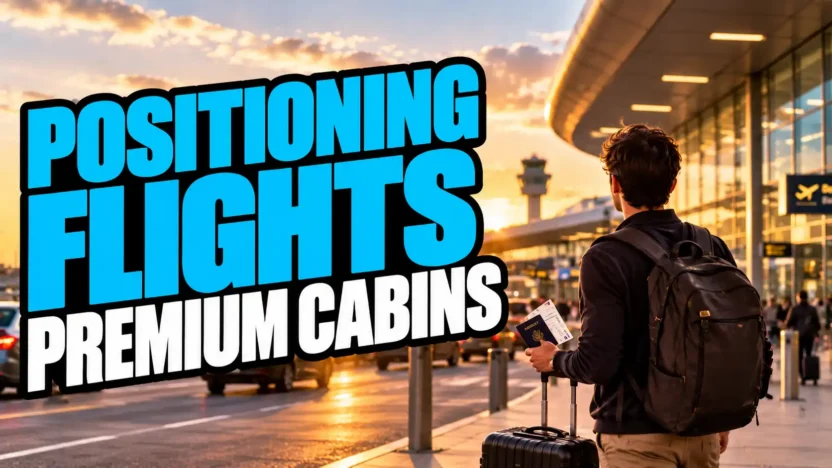
In practical terms, a positioning flight is a short flight you book separately to reach a different airport before starting your main award journey.
The strategy matters most in premium cabins because business and first class award seats are limited to begin with. Airlines release only a handful of premium saver seats per flight, and that scarcity is distributed unevenly across airports.
A coach seat shortage from your home airport is usually solvable with patience. A business class shortage often is not, which is why positioning becomes a more serious consideration once you move into premium cabins.
How Positioning Flights Unlock Better Award Availability
Award space does not open evenly across every airport an airline serves. Some cities consistently show more premium inventory than others, and understanding why helps you decide where positioning actually pays off.
Three factors usually explain the gap:
| Factor | Why It Matters |
|---|---|
| Hub competition | Hub airports see more carriers competing for the same passengers, which pushes airlines to release more award seats to stay competitive. |
| Alliance routing | Partner airlines often release award space more generously on routes that connect through their own alliance hubs. |
| Aircraft type | Wide-body aircraft on hub routes carry more premium seats in total, which increases the odds that some will be released for awards. |
This is where positioning flights for premium cabins earn their reputation. Instead of waiting for your home airport to release a seat that may never appear, you shift the search to an airport where the odds are already in your favor.
When a Positioning Flight Is Worth the Risk (and When It Isn’t)
Every positioning flight adds a decision, not just a flight. The question is not whether positioning works; it is whether it is worth it for this specific trip.
Use this framework to think it through:
| Consider Positioning When | Skip Positioning When |
|---|---|
| The cabin upgrade (economy to business or business to first) is significant | The award difference is small or inconsistent |
| You have a generous buffer between flights (4+ hours domestic, more for international) | Your schedule is tight, or the trip has firm deadlines |
| The positioning route has reliable, frequent service | The positioning route depends on a single daily flight |
| You are comfortable managing two separate bookings | You need one airline to be accountable if plans change |
A positioning flight is a tool for high-value trades, not a habit to apply on every booking. The bigger the gap between your current option and the premium seat you want, the more the added effort is justified.
Positioning Flights vs. the “Hack” Mentality: A Business Class Example
Treating positioning as a quick hack misses the point. The value comes from a deliberate comparison, not from blindly copying a trick you read somewhere.
Before: A traveler searches business class from a mid-size home airport and finds nothing available for three months straight. They assume the route is simply sold out of awards.
After: The same traveler checks a major hub two hours away by a short domestic flight. Business class award seats are consistently available on the connecting long-haul route. Adding the short positioning flight turns an impossible search into a realistic one.
The difference is not luck. It is the decision to treat the home airport as a starting assumption instead of a fixed constraint, which is what separates a positioning flight hack from an actual positioning strategy.
Common Mistakes That Turn a Smart Positioning Flight Into a Costly One
Positioning flights fail for predictable reasons, and most of them come down to timing or ticketing choices rather than the strategy itself.
| Mistake | Why It Hurts |
|---|---|
| Booking too little buffer time | A short delay on the positioning leg can cause you to miss the main award flight entirely |
| Relying on a single daily flight | One cancellation leaves no backup option for reaching your main flight on time |
| Ignoring separate-ticket risk | Airlines are not required to help you if a separate positioning ticket causes a missed connection |
| Overlooking overnight or time zone gaps | A positioning flight that lands late at night can force an unplanned hotel stay |
| Positioning for a small award gain | The time and risk cost more than the cabin upgrade is actually worth |
Avoiding these mistakes is less about finding a perfect formula and more about asking the right questions before you book, not after.
How Flightpoints Simplifies Positioning Flight Decisions
Comparing award availability across multiple airports and multiple loyalty programs by hand takes real time. Most travelers check one or two options, then settle for whatever is available, even when a better seat exists a short flight away.
Flightpoints removes that manual guesswork. Instead of running separate searches across airline sites, the platform brings award availability into one place so you can see where premium seats actually open up.
- Alerts help you track premium award availability without repeatedly checking it yourself.
- Routes make it easier to compare positioning options and see how different starting airports affect your award search.
- Explore supports flexible planning when you are weighing more than one possible route or destination.
The goal is not to find more points to spend. It is to help you make a clearer decision about how to use the points you already have.
Conclusion
A positioning flight is not a shortcut; it is a decision that trades added effort for access to premium award space your home airport may never release.
The strategy works best when the cabin upgrade is significant, the buffer time is realistic, and the positioning route itself is reliable. Skip it when the award gap is small, or your schedule leaves no room for error.
Treating positioning as a deliberate comparison, rather than a trick to copy, is what separates a redemption that works from one that falls apart at the gate. Flightpoints exists to make that comparison easier, surfacing where premium award availability actually sits instead of leaving you to search airport by airport on your own.
If you want to see how your own routes compare, explore Flightpoints and check what premium award availability looks like beyond your home airport.
Discover the True Value of Your Points
Ready to see what your points are really worth? Get Flightpoints Pro and find the cheapest award seat across every program in seconds.
Get Flightpoints ProFAQs
Q: Is a positioning flight the same as a layover?
No. A layover is part of one single ticket, booked and protected by the same airline. A positioning flight is a completely separate booking, often on a different airline, with no guaranteed protection if something goes wrong between the two flights.
Q: Do positioning flights count toward airline elite status?
It depends on the airline and the fare class you book. Many positioning flights are booked on low-cost carriers or basic fares that earn reduced or no elite-qualifying credit, so check the specific program’s earning rules before you book.
Q: Can I book a positioning flight on the same ticket as my award flight?
Usually not, since the two flights typically involve different airlines or programs. Some loyalty programs do allow you to add a connecting segment within their own network, which removes some of the separate-ticket risk, so it is worth checking before assuming you need two bookings.
Q: How much time should I leave between a positioning flight and my main award flight?
A common guideline is at least four hours for domestic connections and more for international routes, though the right buffer depends on flight frequency and how costly a missed connection would be. Routes with only one daily flight deserve extra caution and a longer buffer than routes with several options per day.