
Table of Contents
TL;DR
- Airline seat maps rarely show how full a flight actually is, so they shouldn’t be your only way to judge seat availability.
- The best way to check remaining seats is by combining airline seat maps with a reliable flight availability checker that looks beyond visible seat assignments.
- Empty seats don’t always mean unsold seats. Many passengers haven’t selected seats yet, while others are blocked for elite members, crew, or operational reasons.
- Award seat availability and cash ticket availability are completely different. A flight may have seats for sale but no award seats left.
- If you’re hoping for upgrades, better seats, or award flights, checking seat availability at the right time can make all the difference.
You open your airline app a week before departure and notice half the cabin looks empty. Great, your flight isn’t full, right? Maybe. Or maybe every one of those seats has already been sold.
One of the biggest misconceptions travelers have is believing a seat map shows exactly how many seats are left on a flight. In reality, airlines manage inventory using pricing systems, fare buckets, and operational blocks that passengers never see.
So if you’re wondering how many seats are left on a flight you wanna hop on, here’s what actually works and what doesn’t.
Why Seat Maps Can Be Misleading

The first place most people check is the airline’s seat selection page. While it’s useful, it doesn’t tell the whole story.
An “empty” seat can mean several different things:
- Nobody has booked it yet.
- Someone bought the ticket but skipped seat selection.
- The airline is saving it for elite travelers.
- It’s blocked for crew or operational reasons.
- It’s temporarily unavailable because of aircraft balance or maintenance.
That means a flight can be completely sold out while still showing dozens of open seats on the map. Likewise, a nearly full-looking cabin doesn’t always mean the flight is full.
When checking seat availability, think of the seat map as a seating chart-not an inventory system.
The Best Ways to Check Seat Availability
If you want a more accurate picture of how full a flight is, use more than one source.
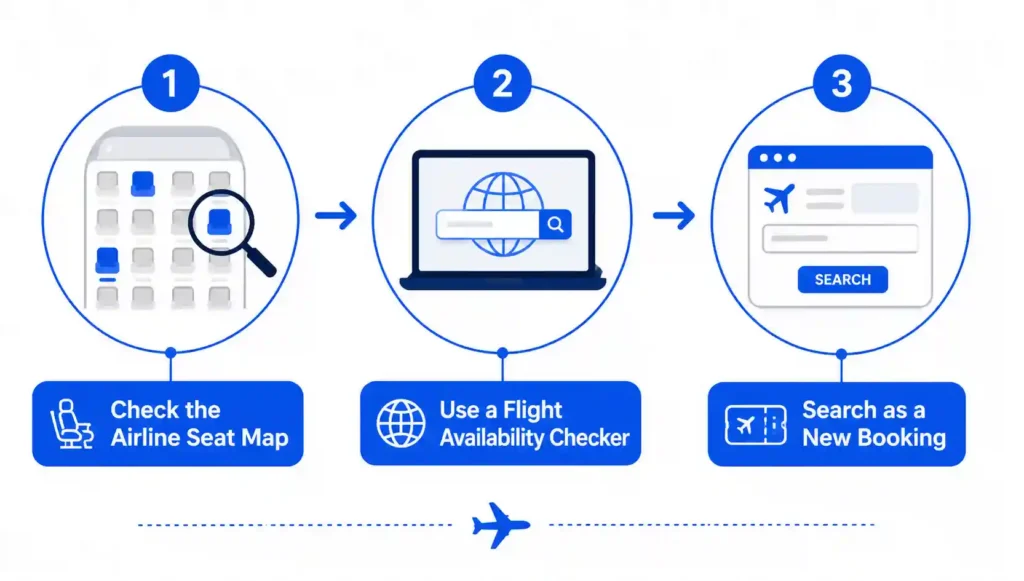
Here are the most reliable methods.
1. Check the Airline Seat Map
This gives you a rough idea of occupied and available seats. It’s especially useful if you’re trying to pick a better seat or estimate how crowded the cabin might feel.
Just remember that it isn’t a true measure of seat availability.
2. Use a Flight Availability Checker
A dedicated flight availability checker looks beyond visible seat assignments. Instead of only showing where passengers are sitting, these tools analyze the airline’s inventory and available booking classes to estimate how many seats are still being sold.
For travelers hoping to book last-minute flights, monitor upgrades, or track award space, this is usually the better option.
3. Search as a New Booking
One surprisingly effective trick is pretending to book the flight again.
Try searching for:
- 1 passenger
- 2 passengers
- 4 passengers
- 8 passengers
If the booking suddenly fails when searching for larger groups, it’s often a sign that only a handful of seats remain. While not perfect, it’s a simple way to estimate seat availability without any specialized tools.
What Actually Determines Flight Availability?
Airlines don’t sell physical seats. They sell fare inventory. Every seat belongs to a pricing bucket that opens and closes depending on demand.
As cheaper fare buckets sell out, airlines simply offer the remaining seats at higher prices-even though the physical seat hasn’t changed. That’s why ticket prices often increase even when plenty of seats appear available.
For award travelers, things become even more complicated. An airline might still have dozens of seats available for cash purchase while releasing zero seats for miles because award inventory is managed separately.
When Should You Check Seat Availability?
Timing matters. The closer a flight gets to departure, the more information becomes available.
Here’s when checking makes the biggest difference.
| Time Before Flight | What Usually Happens |
|---|---|
| Several weeks out | Many passengers haven’t selected seats yet. |
| 48 hours before departure | Airlines finalize aircraft assignments and operational blocks. |
| 24 hours before departure | Online check-in opens, unassigned passengers receive seats, and blocked seats are often released. |
| Boarding time | Last-minute cancellations and no-shows may free up additional seats. |
If you’re hoping for an upgrade or a better seat, checking seat availability around the 24-hour mark often gives the clearest picture.
Can You Tell If a Flight Is Full?
Not with complete certainty. Airlines don’t publicly publish exactly how many seats remain for sale.
However, combining multiple methods gives you a surprisingly accurate estimate:
- Airline seat maps
- Booking searches for multiple passengers
- A trusted flight availability checker
- Award search tools for points bookings
Together, they provide a much clearer picture than relying on any single source.
Skip the Guesswork With Flightpoints
If you’re booking flights with points, seat availability becomes even more important.
Award inventory changes constantly, and manually checking multiple airline websites can quickly become frustrating.
Flightpoints helps by searching award availability across more than 25 airline loyalty programs at once.
Here’s how it helps:
- Search multiple programs together: Compare award availability across airlines without opening dozens of tabs.
- See bookable seats in real time: Find live award inventory before transferring your points.
- Track seat alerts: Receive notifications when award seats become available instead of checking every day.
Instead of wondering whether an award seat still exists, you can verify availability before making an irreversible points transfer.
Conclusion
Checking seat availability is about much more than looking at a seat map. Modern airlines manage inventory using dynamic pricing, fare buckets, elite seat blocks, and operational restrictions that passengers rarely see.
If you’re simply choosing a seat, the airline’s seat map is usually enough. But if you’re trying to figure out how full a flight really is or you’re planning to book with points, a dedicated flight availability checker gives you a much better understanding of what’s actually available.
The smartest travelers don’t ask, “How many empty seats do I see?” They ask, “How many seats can still be booked?”
Knowing the difference can help you snag better seats, improve your upgrade chances, and book award flights before they’re gone.
FAQs
Q: Can I see exactly how many seats are left on a flight?
A: Not usually. Airlines don’t publicly display their remaining inventory, but seat maps, booking searches, and a flight availability checker can provide a reliable estimate.
Q: Does an empty seat map mean the flight isn’t full?
A: No. Many passengers don’t select seats until check-in, and airlines also block seats for operational or elite-status reasons.
Q: What’s the best flight availability checker?
A: Tools that search live airline inventory or award availability generally provide more accurate information than seat maps alone, especially for points bookings.
Q: When should I check seat availability?
A: Around 24 hours before departure is often the best time, as online check-in opens and airlines begin assigning previously unselected seats.
Q: Are award seats different from regular seats?
A: Yes. Airlines manage award inventory separately, so a flight can have cash seats available while showing no award seats at all.