
Table of Contents
You have a stack of Chase points sitting in your account and an Air France or KLM flight you want to book. Moving chase points to flying blue looks simple on the surface, but the order you do things in matters more than most guides admit. Transfer too early and you risk stranding points in a program you did not need. Transfer too late and the seat you wanted is gone.
So how do you know when to transfer, how long it actually takes, and whether waiting for a bonus is worth the risk? Those are the three questions this guide answers.
In this article, we walk through the full transfer process, the eligible cards, realistic timing, and the trade-offs you need to weigh before you move a single point.
TL;DR
- Chase points transfer to Flying Blue at a 1:1 ratio, in increments of 1,000.
- The transfer is one-way. Once points leave Chase, they cannot come back.
- Confirm your Flying Blue award seat before you transfer, not after.
- Transfer times are usually fast, but delays happen during high-demand periods.
- Waiting for a transfer bonus only makes sense if the seat is unlikely to sell out first.
What Happens When You Transfer Chase Points to Flying Blue

A transfer from Chase to Flying Blue moves points out of your Ultimate Rewards account and converts them into Flying Blue miles. The exchange happens at a 1:1 ratio, so 1,000 Chase points become 1,000 Flying Blue miles. You cannot transfer partial amounts below 1,000 points, and every transfer after that must move in 1,000-point blocks.
The part that trips people up is not the math. It is the finality. Once your points land in Flying Blue, Chase will not reverse the transfer, even if you change your mind minutes later. This is why the transfer decision should come after you have already found and priced the award seat, not before.
| What you’re moving from | What you’re moving to | Ratio | Minimum transfer |
|---|---|---|---|
| Chase Ultimate Rewards | Flying Blue miles | 1:1 | 1,000 points |
Chase to Air France: Which Cards Are Eligible
Not every Chase card lets you make this transfer. The chase to air france move only works if your points are already in the transferable Ultimate Rewards format, not locked into a cash-back-only card.
Cards that typically carry transferable Ultimate Rewards include:
- Chase Sapphire Preferred
- Chase Sapphire Reserve
- Chase Ink Business Preferred
- Chase Ink Business Unlimited (when paired with a transferable card on the same account)
If your points currently sit on a cash-back card like Chase Freedom, you may be able to combine them into a transferable account first, depending on which cards you hold. This step matters because it determines whether you can access Flying Blue at all, so confirm it before you plan around a transfer.
Step-by-Step: How to Transfer Chase Points to Flying Blue
The mechanics are straightforward, but the sequence protects you from wasted points. Follow this order rather than jumping straight to the transfer screen.
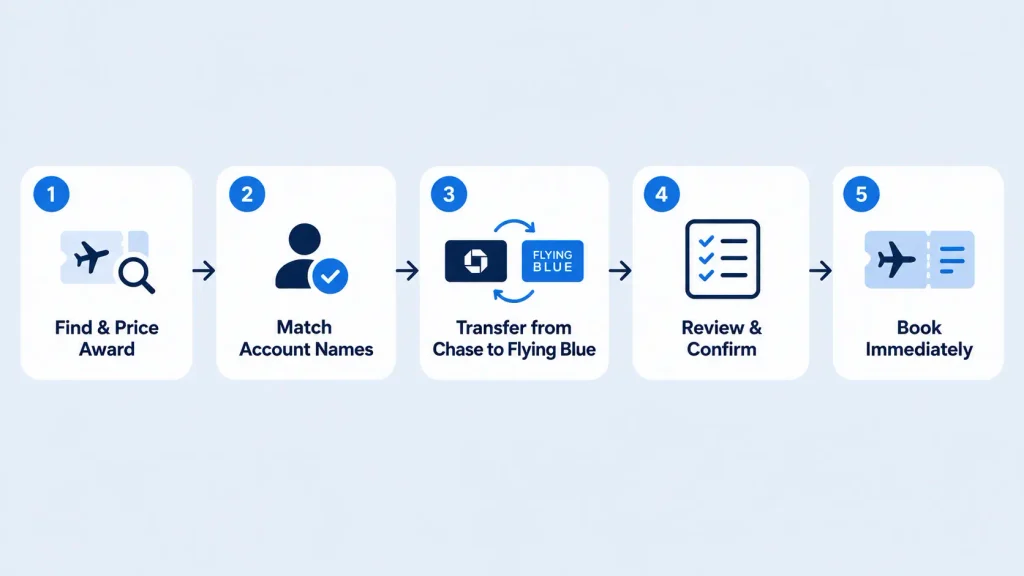
- Find and price the award seat first. Log in to Flying Blue or use a search tool to confirm the flight you want is bookable with miles right now.
- Check that the account names match exactly. Chase requires your Flying Blue profile name to match your Chase account name, including middle initial and suffix.
- Log in to Chase and select Flying Blue as the transfer partner. Enter the number of points in 1,000-point increments, with a small buffer above the award price in case it shifts slightly.
- Review and confirm the transfer. You will get a confirmation email from both Chase and Flying Blue once it processes.
- Book the seat immediately. Award space can disappear within minutes, so this is not a step to delay.
This order matters because it removes the biggest risk in the process: transferring points before you know a seat exists.
Flying Blue Chase Transfer Time: What to Expect
One of the most common questions before transferring is simple: how long will it take? The honest answer is that flying blue chase transfer time is usually fast, but not guaranteed to be instant.
| Scenario | Typical timing |
|---|---|
| Standard transfer, normal demand | A few minutes to under an hour |
| High-demand periods (holidays, promotions) | Several hours, occasionally longer |
| Bonus miles from a promotion | Up to seven days to post separately |
Base miles from your transfer usually post quickly. Bonus miles tied to a promotion follow a separate timeline and can take up to a week to show up, even though your base transfer completed already. If you are transferring specifically to hit a bonus deadline, plan around the base transfer time, not the bonus posting time.
Should You Wait for a Transfer Bonus?
Chase occasionally runs bonus transfer promotions to Flying Blue, boosting your points by 20 to 25 percent. Waiting for one can stretch your points further, but it comes with a real tradeoff: the seat you want might not wait with you.
| Wait for a bonus if | Transfer now if |
|---|---|
| Award space for your route is consistently available | The seat you want is limited or waitlist-only |
| You have flexible travel dates | Your dates are fixed and non-negotiable |
| The bonus is announced and has a clear end date | No bonus is currently active or rumored |
| You are booking a common route with steady inventory | You are booking a rare route, like a single daily premium cabin seat |
The decision comes down to how replaceable the seat is. A popular economy route with daily departures can usually absorb a short wait. A single premium cabin seat on a less frequent route usually cannot.
Common Mistakes When Transferring Chase Points to Flying Blue
Most problems with this transfer come from skipping a step rather than misunderstanding the ratio. Watch for these before you transfer.
- Transferring before confirming the seat. This is the most common and costly mistake, since the transfer cannot be undone.
- Assuming names auto-match. A mismatch between your Chase and Flying Blue profile names can delay or block the transfer.
- Ignoring the 1,000-point minimum. You cannot transfer a partial amount, so round your points accordingly.
- Waiting on a bonus for a scarce seat. The savings from a bonus rarely offset losing the seat entirely.
- Forgetting that bonus miles post separately. If you are booking against a bonus, do not assume all your miles have landed at once.
How Flightpoints Simplifies This Decision
Even once you understand the mechanics, figuring out whether Flying Blue is the right partner for a specific trip takes real comparison work. You have to check award availability, compare it against other transfer partners, and time your move around bonuses, all before you know if the transfer is worth making.
Flightpoints was built for exactly this kind of decision. Instead of manually checking Flying Blue against every other program tied to your Chase points, flightpoints helps you see the trade-offs in one place.
- Alerts flag when award availability opens up on routes you are watching, so timing your transfer is less of a guessing game.
- Routes let you compare how far your points go across different transfer partners, not just Flying Blue, before you commit.
The goal is not to add another tool to check. It is to remove the manual comparison work that leads to rushed or reversed decisions.
Conclusion
Transferring chase points to flying blue is simple in mechanics but unforgiving in sequence. The ratio is fixed, the transfer is irreversible, and the biggest risk is moving points before you have confirmed a seat exists. Once you treat the transfer as the last step rather than the first, most of the common mistakes disappear on their own.
This is the kind of decision that gets easier with the right comparison in front of you, rather than a dozen open browser tabs. flightpoints exists to give you that comparison, so you can weigh Flying Blue against your other options before you commit a single point.
If you want to see how your Chase points stack up across transfer partners before your next transfer, explore flightpoints to compare your options.
FAQs
Q: Can you transfer Flying Blue miles back to Chase?
A: No. Once Chase points convert into Flying Blue miles, the transfer cannot be reversed. This is true across nearly all Chase transfer partners, not just Flying Blue, so treat every transfer as final before you confirm it.
Q: Do Flying Blue miles expire?
A: Flying Blue miles can expire if your account has no activity for a set period, though earning or redeeming miles typically resets the clock. Check your account status directly with Flying Blue before assuming your balance is safe long term.
Q: How many Chase points do I need for a flight to Europe?
A: The number varies widely by cabin, route, and season, since Flying Blue uses dynamic pricing rather than a fixed award chart. Economy awards can start relatively low, while premium cabins require significantly more, so always price the specific flight before transferring.
Q: Is Flying Blue a good transfer partner compared to booking directly with Air France?
A: It depends on the route and cabin you want. Flying Blue miles can unlock strong value on SkyTeam partner awards that are not always visible when searching Air France directly, but availability and pricing shift often, so comparing both before transferring is worth the extra step.
Q: What happens if the transfer takes longer than expected?
A: If your points have not posted within a few hours, check your Flying Blue account activity and your Chase confirmation email before contacting support. Delays are more common during high-demand periods, and most resolve within the same day.