Table of Contents
Most airfare advice assumes you’re planning ahead: book 6–8 weeks out for domestic, 3–6 months out for international, watch the calendar, set fare alerts, time the dip. But that advice falls apart for the increasingly common traveler who books trips three days, three hours, or three minutes before they happen. Whether it’s a last-minute work trip, a friend’s wedding you suddenly need to attend, a weekend getaway decided at lunch on Thursday, or a flight booked at the airport gate — spontaneous travel is a real category, and the airlines that serve it well are very different from the ones optimized for advance planners.
The reality of 2026 airline pricing: most carriers charge dramatic premiums for last-minute bookings, sometimes 30–50% more than the equivalent advance fare. A few airlines, however, maintain remarkably stable pricing right up to departure — and a couple actually drop their fares as the flight gets closer. If you’re a spontaneous booker, knowing which is which can save you thousands of dollars per year.
This guide covers exactly which airlines maintain stable pricing for last-minute and spontaneous bookings in 2026, verified with current data. We’ll break down the carriers that reward flexibility, the ones that punish it, the booking strategies that work across pricing models, and how to find the best last-minute deals across the industry.
The 2026 Reality: Last-Minute Pricing Has Diverged Sharply by Carrier
The single most important fact about spontaneous booking in 2026 is that airlines no longer follow the same pricing playbook. The old conventional wisdom that “all airlines charge more for last-minute fares” is no longer accurate. According to mid-2026 industry data analyzing airfare across major US carriers:
That’s a roughly 50-point gap between the best last-minute airline (Alaska) and the worst (JetBlue). For travelers booking under 72 hours out, the airline you choose matters more than almost any other variable.
Why do prices diverge so much? The answer comes down to who each airline is built to serve. JetBlue, the legacy carriers (American, Delta, United), and most international airlines optimize for business travelers — passengers who book under tight time pressure and have less price elasticity. These airlines layer premium pricing on last-minute fares because business travelers will usually pay. Alaska, Southwest, Spirit, and Frontier optimize for leisure travelers — passengers who shop on price first. These airlines maintain consistent pricing because leisure customers will simply book somewhere else if last-minute fares spike.
The Most Stable Airlines for Spontaneous Booking in 2026
Here are the carriers that earned their reputations for stable pricing, ranked by the price difference between advance and last-minute booking.
1. Alaska Airlines — The Best Last-Minute Airline in 2026
Alaska Airlines is the standout in this category. Mid-2026 data showed Alaska’s last-minute one-way fares averaging 22.6% lower than the equivalent advance booking. That’s not a typo — Alaska’s pricing structure actually rewards spontaneity in many cases, with last-minute fares often dropping below the prices available three or four weeks before departure.
Why Alaska’s pricing stays low last-minute:
- Strong leisure-traveler base on West Coast routes and Hawaii routes
- Less business-traveler dependency than legacy carriers
- Robust hub-and-spoke network across Seattle, Portland, San Francisco, and Los Angeles with frequent flights creating competitive intra-route pricing
- Strategic interest in filling unsold seats rather than maximizing yield per ticket
Best routes for spontaneous booking on Alaska:
- Seattle (SEA) to Portland (PDX), San Francisco (SFO), Los Angeles (LAX), San Diego (SAN), Las Vegas (LAS)
- Pacific Northwest to Hawaii — Honolulu, Maui, Kauai, Big Island
- Anchorage and other Alaska intra-state routes
- West Coast to East Coast transcons (especially Seattle and San Francisco to New York, Boston)
One important caveat: Alaska now flies under the Atmos Rewards loyalty program (rebranded from Mileage Plan in August 2025). Atmos Rewards points have no expiration and can be used for last-minute award bookings — so if you’re spontaneous on the cash side, you can also burn miles on Alaska last-minute without losing them to inactivity.
2. Southwest Airlines — Stable Pricing With Major 2026 Changes
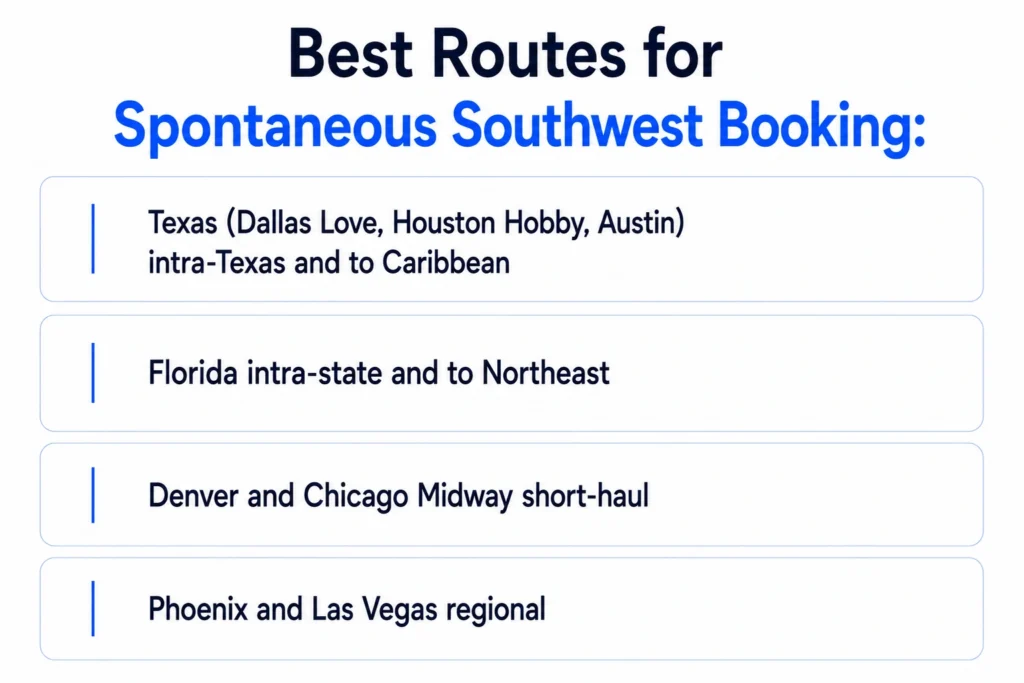
Southwest historically built its reputation on transparent, stable pricing. Mid-2026 data still shows Southwest’s last-minute fares averaging 8.2% below advance bookings — the second-best stability in the US market. But Southwest in 2026 is significantly different from Southwest in 2024, and the changes affect how you should think about booking spontaneously.
Key 2026 Southwest changes:
- Assigned seating rolled out January 27, 2026 (ending the open-seating tradition that defined the airline since 1971)
- Checked bag fees introduced May 28, 2025: $35 for the first bag, $45 for the second, ending the “Bags Fly Free” policy
- Four fare bundles replaced the old system: Basic (formerly Wanna Get Away), Choice, Choice Preferred, and Choice Extra (formerly Business Select)
- Eight-group boarding system replaced the A1–C60 ladder
- Tier elite benefits expanded for A-List and A-List Preferred members
Despite the changes, Southwest’s underlying fare structure remains stable to departure. The “Wanna Get Away” model (now “Basic”) still produces last-minute fares meaningfully below the legacy carriers. Where Southwest used to win on bag-and-seat experience, it now wins primarily on fare transparency: no hidden change fees, points that never expire, no blackout dates on Rapid Rewards redemptions, and uncapped reward seat availability. For 2026 spontaneous bookers, Southwest is still strong — but compare the all-in cost (fare + bag fees + seat selection) rather than the base fare alone.
3. Frontier Airlines — Cheap Last-Minute With the Same Ultra-Low-Cost Caveats
Frontier sits in the same competitive category as Spirit. Mid-2026 data showed Frontier’s last-minute fares averaging 3.6% below advance bookings, at $160.89 one-way. The pricing rewards basic fares and punishes anything beyond — carry-on bag ($35–$65), checked bag ($30–$65), seat selection ($5–$50+), or the “Works” bundle for normal airline amenities (~$60+ per leg).
For spontaneous bookers traveling light, Frontier is highly competitive. For travelers wanting checked bags, seat selection, or refreshments, the legacy carriers may match the total cost. Frontier’s “GoWild!” pass program also works well for spontaneous travelers willing to take last-minute availability.
4. Allegiant Air — The Hidden Stable-Pricer
Allegiant deserves mention as a stable-pricing carrier with a unique model: it flies primarily from smaller US cities (Bismarck, Fargo, Asheville, Provo) to leisure destinations (Las Vegas, Phoenix, Florida, Myrtle Beach) on a limited weekly schedule. The leisure-only mix keeps last-minute pricing stable.
The trade-off: Allegiant flies many routes only 2–4 days per week, so spontaneity has scheduling constraints. If your travel day aligns with an Allegiant departure, the price is usually competitive even at the last minute.
Airlines That Charge Premiums for Last-Minute Booking (and Why)
Just as important as knowing which airlines reward spontaneity is knowing which ones punish it. In 2026, the carriers most likely to spike last-minute fares are:
JetBlue Airways (29.9% premium)
JetBlue posts the largest last-minute premium of any major US carrier — 29.9% above the equivalent advance booking on average. Mid-2026 average last-minute one-way fares were $310.15, compared to $238.79 for advance bookings of the same routes.
Why? JetBlue’s hub network in New York (JFK), Boston, and Fort Lauderdale draws significant business traveler volume on routes to Florida, the Caribbean, and the Northeast. The airline can extract premium pricing from time-pressed bookers on these routes. JetBlue’s transatlantic and Mint business class fares show similar dynamics — last-minute Mint fares to London and Paris can run 40–60% above advance equivalents.
American, Delta, and United (10–25% premium on average)
The three major US legacy carriers all use dynamic pricing models heavily influenced by business-traveler willingness to pay. Last-minute fares average 10–25% above advance bookings on most routes, with the steepest premiums on:
- Business-heavy routes (NYC-Boston, NYC-Chicago, NYC-DC, NYC-SF, NYC-LA, Atlanta-anywhere)
- Premium cabin (business and first class) tickets
- Single-day round trips priced as separate one-ways
- Travel within 7 days of departure on Mondays, Tuesdays, and Thursdays (peak business travel days)
The legacy carriers’ lowest last-minute fares tend to be:
- Sunday and Saturday departures (off-peak business days)
- 7–10 days out rather than 1–3 days out
- Routes with strong leisure demand that compete with Spirit/Frontier
International Carriers (Variable, Generally High)
Most international airlines charge premium last-minute fares, with Air France, Lufthansa, British Airways, and Cathay Pacific posting some of the largest premiums in the industry. Asian carriers (Singapore Airlines, ANA, JAL) tend to maintain slightly more stable pricing — but only in economy. Last-minute business class on international carriers can easily run 50–100%+ above advance equivalents.
Booking Strategies for Spontaneous Travelers in 2026
Beyond choosing the right airline, several strategies maximize value for last-minute and spontaneous bookings:
1. Use points/miles for routes with award space. Award flights tend to maintain stable pricing right up to departure, because the airline has either released saver-level inventory or it hasn’t. Programs like Alaska Atmos Rewards, Southwest Rapid Rewards, and JetBlue TrueBlue have predictable award charts and uncapped reward seat availability. If your cash fare looks high, check the equivalent award cost — sometimes a 25,000-mile redemption beats a $400 last-minute fare.
2. Compare across airlines and across booking channels. Spontaneous bookers often default to their preferred carrier without checking alternatives. Mid-2026 data shows the same route can vary by 40–60% across carriers booked at the same time. Always check at least three airlines for any spontaneous trip.
3. Set Instant Alerts for routes you frequently travel. Spontaneous bookers often have repeating destinations. Setting alerts catches saver award space, promotional cash fares, and price drops the moment they appear — turning “spontaneous” booking into “spontaneous with a lead time of minutes” rather than “spontaneous and overpaying.”
4. Book one-way tickets and combine if needed. Many last-minute round-trip fares price worse than two one-way tickets purchased separately. For spontaneous trips, always check one-way pricing — sometimes you can book outbound on one carrier and return on another for substantial savings.
5. Use credit card points with low-friction redemption pathways. Programs like Capital One Miles’ “purchase eraser,” Chase Sapphire Reserve’s “Pay Yourself Back,” and Amex MR’s flight booking through Amex Travel let you book any cash fare and use points at a 1.25–1.5 cent per point rate. For last-minute bookings where flexible award space isn’t available, these tools turn cash-only fares into miles-payable purchases.
How Flightpoints Helps Spontaneous Bookers
Spontaneous travel rewards speed. The faster you can identify the cheapest available fare across both cash and award options, the more money you save and the more options you keep open. Flightpoints is built for exactly this use case:
Instant search across 28 airline programs: Enter your route and date, and Flightpoints simultaneously checks award availability and miles cost across every major airline. For spontaneous bookers, this matters because last-minute award space behaves unpredictably — programs may have flight space when others don’t, and the only way to know is searching them all simultaneously.
Instant Alerts: Set up an alert for any route you’re considering, with your target price or miles cost. When availability matches your criteria, you get a push notification immediately. For spontaneous travelers, this means you don’t have to be actively searching to catch good fares — alerts find them for you.
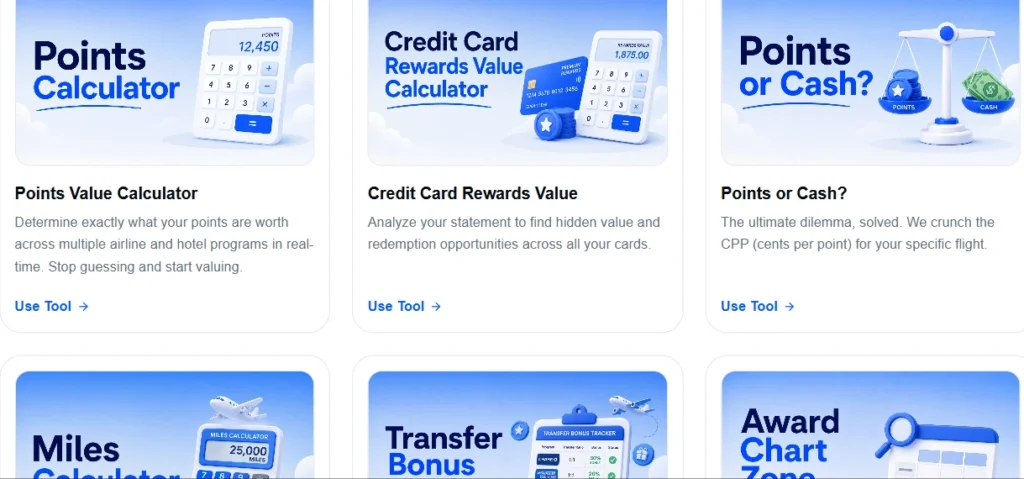
Check Points vs Cash: Compare the cash price and the award miles cost side-by-side, with automatic cents-per-point calculations. For spontaneous travelers, this lets you decide in seconds whether your situation calls for a cash booking or a miles redemption.
CPP Calculator: Verify that any last-minute redemption produces fair value. A late-booked award that costs 50,000 miles for a flight worth $600 (1.2 cents per point) might be poor value compared to the equivalent cash booking. The CPP tool keeps you from burning miles when cash makes more sense.
Mobile app: The Flightpoints mobile app puts the entire search platform on your phone. Spontaneous bookers often need to book from the airport, the parking lot, or during a 15-minute lunch break — the mobile experience matters more than the desktop one. The Flightpoints app is the only award search tool truly built for mobile-first booking.
Bottom Line: Spontaneous Booking Is About the Airline, Not the Timing
The most important takeaway for 2026 spontaneous travelers is that the conventional wisdom about last-minute fares is wrong for several major US airlines. Alaska Airlines and Southwest Airlines actually maintain stable or lower pricing right up to departure. Spirit and Frontier hold steady. Allegiant rewards spontaneity on leisure routes. The carriers that punish last-minute bookers — JetBlue at the top, plus the legacy carriers on business-heavy routes — are real, but they’re now the exception rather than the rule.
For spontaneous bookers in 2026, the best strategy combines two things: default to airlines with stable pricing on your typical routes, and use a points and miles strategy to handle the rest. Holding balances of Alaska Mileage Plan (Atmos Rewards), Southwest Rapid Rewards, and a transferable currency that reaches multiple airlines (Bilt Rewards is best for breadth) gives you reliable spontaneous-booking options across most scenarios.
When cash fares spike — which they will, on some routes, despite the carrier choice — switching to miles becomes the fallback. And finding the best miles redemption across 28 airline programs in seconds is exactly what Flightpoints was built for.
Frequently Asked Questions
Q: Which airline has the most stable pricing for last-minute booking?
A: Alaska Airlines has the most stable last-minute pricing among major US carriers in 2026, with last-minute one-way fares averaging 22.6% lower than advance bookings. Southwest Airlines is second at 8.2% lower last-minute. Spirit and Frontier offer marginal last-minute discounts (3–4%). JetBlue is the worst offender, charging a 29.9% premium on last-minute bookings.
Q: Are last-minute flights always more expensive?
A: No, and this is one of the most outdated pieces of airfare advice. While most international carriers and US legacy carriers charge premiums for last-minute booking, Alaska Airlines, Southwest Airlines, Spirit, Frontier, and Allegiant all show stable or lower last-minute pricing on average. The carrier matters more than the booking window.
Q: What’s the best airline for spontaneous weekend trips?
A: For domestic spontaneous weekend trips: Alaska Airlines (West Coast), Southwest Airlines (Texas, Florida, intra-US), Spirit (Florida/Caribbean), and Frontier (Denver/Las Vegas hubs) all maintain stable pricing right up to departure. For more flexibility with seat selection and bags included, Alaska is the most consistent choice.
Q: How can I find last-minute flight deals across multiple airlines at once?
A: Use a comparison platform like Google Flights, Kayak, or Skyscanner for cash fares. For award redemptions, use Flightpoints to search 28 airline programs simultaneously and compare miles cost + cash taxes across every available option for your exact route and date.
Q: Do airline points stay valuable for last-minute booking?
A: Yes, and this is one of the underrated values of holding airline miles. Award flight pricing on programs with published charts (Alaska Atmos Rewards, Southwest Rapid Rewards, JetBlue TrueBlue) stays stable right up to departure. Award flight pricing on dynamic programs (Delta SkyMiles, United MileagePlus) can actually drop in the final 14 days as airlines release unsold premium-cabin inventory. For spontaneous bookers with mileage balances, awards often beat cash fares by 30–50%.
Q: Did Southwest’s 2026 changes affect its last-minute pricing?
A: Not significantly. Southwest’s pricing structure still produces last-minute fares averaging 8.2% below advance bookings as of mid-2026. What changed is the all-in cost: bag fees ($35 first, $45 second), assigned seating costs (varies by seat type), and the new four-fare bundle system. For carry-on-only travelers willing to accept assigned seats, Southwest remains highly competitive for spontaneous booking.
Q: Is JetBlue still worth it for last-minute trips despite the premium?
A: It depends on the route and what you’re paying for. JetBlue’s product (free Wi-Fi, more legroom, decent service) is meaningfully better than ultra-low-cost carriers, which can justify the 29.9% premium on routes where you value the experience. But for pure price-driven spontaneous bookings, JetBlue is no longer the value play it once was — and Alaska, Southwest, or even legacy carriers may be cheaper at the same booking window.
Q: What’s the cheapest way to book a flight one day in advance?
A: For domestic US trips: Alaska Airlines if the route is on their network; Southwest as a strong second; Spirit or Frontier if you’re carry-on-only and don’t mind add-on fees. For international: search award redemptions through a program with stable partner pricing (Aeroplan, Turkish Miles & Smiles, Avianca LifeMiles for Star Alliance; AAdvantage partner awards for oneworld). Last-minute award redemptions often beat last-minute cash fares by 50%+ on international routes.