
Table of Contents
Even experienced travelers waste points. Not because they lack knowledge, but because they don’t search award flights by route correctly. The system is bigger than a search box.
The global loyalty programs market reached US $150.9 billion in 2024. Yet value is shrinking. US airline reward payback has dropped by nearly half since 2019. That means many travelers now get almost 2x less value from poor routing and portal bookings.
Are you searching routes or just typing city pairs?
Most bookings fail before the search even begins. The route is unclear. The options feel endless. You open multiple tabs and still feel unsure.
How many points are you losing without realizing it?
The real shift is simple: stop searching for flights and start building routes. In this blog, you will learn a clear 5-step system to search award flights by route for premium seats with speed and confidence.
Quick Summary
- Route Defines Value, Not Search: The outcome depends on how you structure the route before searching. Better routing directly leads to better premium seat access.
- Poor Search Structure Has a Cost: Fixed searches and limited visibility can double your points cost. Inefficiency is not small. It compounds across every booking.
- Premium Seats Live in Hub Networks: Most long-haul availability sits between major hubs. Ignoring these networks removes the best options from your search space.
- Award Search Is a Layered Process: You need route planning, airline filtering, and availability validation working together. Skipping any layer reduces accuracy.
- Portals Hide More Than They Show: Simplicity comes at a cost. Without route-level visibility, you miss partner pricing and higher-value redemptions.
Why Most Travelers Fail to Search Award Flights by Route Correctly
Most travelers assume better tools will fix poor results. That assumption breaks quickly. Award search is not about tools. It is about constructing the right route before you search, something platforms like Flightpoints are designed to simplify.
The typical workflow looks simple, but it creates blind spots. You search directly, switch tools, and still feel stuck.
Here is what usually goes wrong:
- Direct Origin → Destination Search: You search one fixed city pair. This ignores hub-based routing where most premium seats are released. It limits visibility to a narrow slice of availability.
- Single Tool Dependence: You rely on one interface to show all options. No engine covers full partner inventory consistently. This leads to incomplete results. Most basic tools fail because they are not built as a true award flight discovery platform.
- No Route Mapping: You skip identifying hubs and airline networks. Without this, you search blindly across programs. This increases time and reduces accuracy, especially when you do not have a structured view of routes like what Flightpoints provides.
This creates hidden value loss:
| Action | Outcome | Impact |
|---|---|---|
| Fixed route search | Missed hub connections | Fewer premium seats |
| One tool usage | Partial visibility | Missed routes |
| No mapping | Wrong program choice | Higher points cost |
You already understand points. The gap is structure.
The 3 Hidden Mistakes When You Search Award Flights by Route
Even experienced travelers repeat the same patterns. These mistakes reduce visibility before the search even begins.
Here are the three that matter most:
- Searching City Pairs Instead Of Route Networks: You focus on A to B. Airlines release inventory across multi-segment routes via hubs. This causes you to miss long-haul premium seats hidden behind connections.
- Ignoring Gateway Airports And Repositioning: You expect availability from your home airport. Most premium inventory originates from major hubs. Skipping repositioning removes viable routes from your search.
- Trusting One Tool To Show Complete Availability: You assume results are complete. Tools often miss partner space or show stale data. This leads to missed bookings that exist elsewhere.
Each mistake reduces route visibility. Less visibility means fewer high-value options.
Step-by-Step System to Search Award Flights by Route for Premium Seats
You do not need more tools. You need a structured process. This system gives you control and reduces guesswork across every search.
Follow these steps in order:
Step 1: Define Your Destination Range Before You Search Award Flights by Route
Start with direction, not precision. A rigid plan limits your options early.
- Choose Primary And Backup Destinations: Select one main destination and one or two nearby alternatives. This expands routing possibilities and improves availability chances.
- Set A Date Range Instead Of A Fixed Date: Use a window of days or weeks. Availability aligns with airline release patterns, not specific dates.
- Anchor To Regions, Not Cities: Thinking in regions helps you capture routes that do not align exactly with your first choice. An explore destinations with points approach reveals better options than fixed searches.
Step 2: Map Gateways Before You Search Award Flights by Route
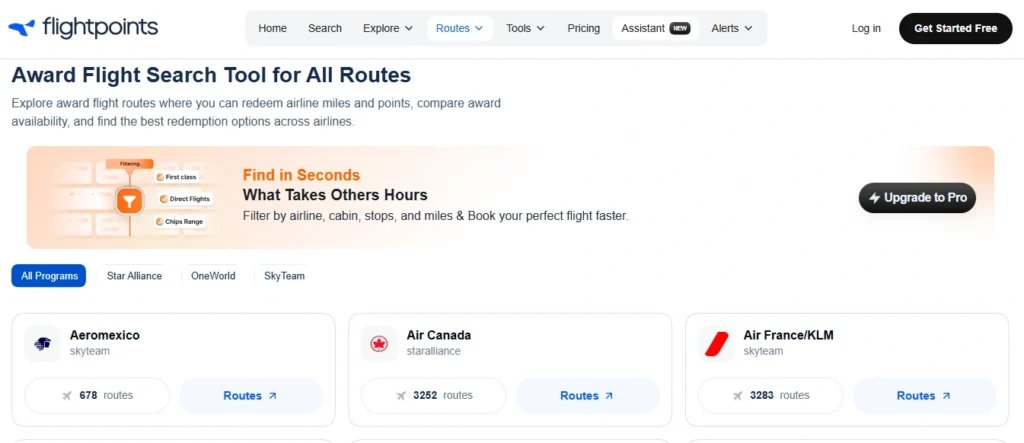
Routes exist between hubs. A flight route planner for points helps you avoid guessing which paths are possible. You need to identify them before searching.
- Identify Departure And Arrival Hubs: Look for major airports near your origin and destination. These are where airlines release premium seats.
- Include Repositioning Flights In Your Plan: A short paid or award flight to a hub can unlock better long-haul options.
- Use Airline Route Maps And Network Views: These help you understand which airlines operate which routes before you search availability.
Step 3: Filter Airlines and Alliances to Search Award Flights by Route Efficiently
Once routes are clear, reduce unnecessary searches.
- Group Airlines By Alliance: Identify whether routes fall under major alliances. This helps you focus on bookable partners.
- Match Routes With Relevant Programs: Not all points can book all flights. Align your currencies with programs that can access those routes. A structured airline miles booking tool helps you align routes with programs faster.
- Eliminate Irrelevant Searches Early: This reduces time spent checking programs that cannot book your target route.
Without a route planning tool for award travel, these higher-value paths remain hidden.
Step 4: Use Discovery and Verification Layers to Search Award Flights by Route
You need two layers to avoid false results.
- Use Discovery For Broad Exploration: Scan for possible routes across dates and regions. This gives you direction, especially when using systems like Flightpoints that surface route-level visibility instead of isolated results.
- Use Verification For Booking Accuracy: Confirm availability before transferring points. This prevents failed bookings.
- Account For Phantom Availability: Some results appear available but are not bookable. Always validate before acting. Using award seat alerts helps you focus only on confirmed openings instead of outdated results.
Step 5: Pivot, Book, and Improve After You Search Award Flights by Route
Perfect routes rarely appear first. Treat this as a process.
- Adjust One Variable At A Time: Change route, date, or gateway individually. This helps isolate what improves availability.
- Book A Workable Option Early: If flexible, secure a decent route before it disappears. This reduces risk.
- Monitor For Improvements After Booking: Better cabins or lower pricing may appear later. Continue checking until departure. A smart points booking tool helps you track changes without restarting the search process.
Advanced Strategies to Search Award Flights by Route More Effectively
Once the system is clear, you can refine it further. These strategies improve results across complex bookings. Timing becomes easier when you rely on flight availability alerts for points instead of manual checks.
Use the following to push your search further:
1. Use Broad Region Searches to Improve How You Search Award Flights by Route
City-level thinking limits your options. Region-level thinking expands them.
- Search Entire Regions Instead Of Single Cities: This increases the number of possible routes and airlines in your results. A flexible award travel search tool helps surface routes you would not consider manually.
- Consider Nearby Airports As Equal Options: Alternate arrival points often have better premium availability.
- Prioritize Access Over Precision: A slightly different city can offer a significantly better route.
2. Account for Taxes and Transfer Timing When You Search Award Flights by Route
Points alone do not define value. Cash components matter.
- Check Taxes And Carrier Surcharges: Some routes carry high fees that reduce overall value.
- Factor In Transfer Bonuses: A bonus can make one program significantly more efficient than another.
- Compare Total Cost, Not Just Miles: Evaluate both points and cash together before deciding.
3. Search Award Flights by Route for Multiple Seats and Family Travel
Group bookings introduce a new constraint. Seat count becomes the limiting factor.
- Search For Fewer Seats First: This reveals availability patterns before scaling up. A points travel explorer helps identify routes that can scale to multiple passengers.
- Split Bookings Across Flights If Needed: Not all passengers need to be on the same itinerary.
- Stay Flexible Across Cabins And Routes: Mixing cabins or routes can make group bookings possible.
Find better destinations without guessing routes. Explore multiple options with Flightpoints and uncover high-value redemptions faster.
Why Credit Card Portals Fail When You Search Award Flights by Route
Credit card portals feel simple. That simplicity hides cost. They are built for ease, not for extracting maximum value from your points.
You see a fixed price and assume it is fair. In most cases, it is not.
Here is what actually happens inside portal bookings:
- Fixed Pricing Replaces Partner Value: Portals convert points into cash equivalents. This ignores partner award charts where the same route can cost far fewer points.
- No Route-Level Optimization: You are shown direct or simple options. Complex hub-based routes with better value are rarely surfaced.
- Limited Airline and Partner Access: Portals do not expose full alliance inventory. Many premium routes remain invisible.
To make the gap clear, compare the outcomes:
| Booking Method | What You See | What You Miss | Impact |
|---|---|---|---|
| Portal Booking | Fixed pricing options | Partner sweet spots | 2x higher point cost |
| Route-Based Search | Multiple routing paths | Full partner access | Higher value per point |
Portals remove flexibility. That flexibility is where the value exists, and it is exactly what route-first tools like Flightpoints are built to restore.
How Flightpoints Helps You Search Award Flights by Route With Clarity
You are not struggling to find flights. You are struggling to decide. Too many tabs, unclear routes, and constant second-guessing slow you down.
Flightpoints reduces that friction by structuring how you search for award flights by route. It focuses on clarity, timing, and visibility across routes.
Here is how its core functions improve your workflow:
- Routes: Clear Route Visibility Before You Search.
- You can explore viable flight paths between regions and hubs. This helps you see which routes actually exist before checking availability. It removes blind searching and aligns your plan with real airline networks.
- Explore: Broader Discovery Without Guesswork.
- You can scan multiple destinations and route combinations at once. This surfaces better options that fixed city searches miss. It helps you identify high-value routes faster.
- Alerts: Timing Without Constant Checking.
- You get notified when seats open on specific routes. This removes the need to manually recheck availability. It ensures you act at the right moment.
These functions work best when stakes are high:
- Premium Cabins: Limited inventory requires precise route and timing awareness.
- Multi-Passenger Trips: Coordinating seats across routes becomes manageable.
- Time-Sensitive Bookings: You act when availability appears, not after it disappears.
Flightpoints replaces scattered searching with structured decision-making.
Conclusion
Searching for award flights is not about typing cities. It is about building the right route first. When you shift to route-first thinking, you see better paths, better programs, and better timing. That is where value appears. Are you choosing the best route or just the first one you find? The more structured your approach becomes, the more consistent your results will be.
Flightpoints fits into this process as a decision layer, not just a search layer. Its Routes, Explore, and Alerts functions help you see viable paths, scan better options, and act at the right time. This reduces guesswork and improves confidence when you book premium seats or plan multi-passenger trips.
Discover the True Value of Your Points
Ready to see what your points are really worth? Get Flightpoints Pro and find the cheapest award seat across every program in seconds.
Get Flightpoints ProFAQs
Q: How do you evaluate mixed-cabin itineraries when you search award flights by route for premium seats?
A: Mixed-cabin routes can still deliver strong value if the long-haul segment is premium. Focus on where comfort matters most. Compare total points against full-business options to ensure the tradeoff is justified.
Q: When you search award flights by route, how do you decide between booking early or waiting for better availability?
A: Early booking secures baseline availability, especially for peak routes. Waiting can reveal better cabins or lower pricing. Your decision should depend on flexibility and cancellation rules of the program you use.
Q: How can you optimize stopovers when you search award flights by route for complex itineraries?
A: Stopovers can add value by turning one trip into two destinations. Some programs allow free or low-cost stopovers. Evaluate total routing distance and rules before structuring the itinerary.
Q: What factors should you compare when you search award flights by route across multiple loyalty programs?
A: Compare mileage cost, taxes, transfer ratios, and seat access across programs. Some programs restrict partner availability. The best option balances total cost, flexibility, and booking reliability.