
Table of Contents
The Short Version
- No alliance wins outright. Star Alliance takes coverage, Oneworld takes premium cabins, and SkyTeam takes transatlantic value, so the right pick is the one your routes and points already favor.
- Your credit card currency quietly decides your alliance access. Chase leans Star and Oneworld, Amex reaches all three, and that’s often a bigger constraint than which carrier flies your home airport.
- The same seat can cost wildly different amounts depending on the program you book through, which is why partner award pricing, not the airline’s own chart, is where the real savings hide.
- 2026 reshuffled the board: ITA Airways moved to Star Alliance, Hawaiian joined Oneworld, and the Korean Air–Asiana merger redraws Star’s footprint in Asia by December.
- Credit card travel portals can charge two to four times more points than a smart partner booking for the same flight, making the portal the costliest trap in award travel.
You have points stacking up across Chase, Amex, or Capital One, and a trip you want to book in a flat business-class seat. The question isn’t whether you have enough miles. It’s which of the three global airline alliances actually turns those miles into the flight you want, for the fewest points. So which one wins? There’s no single answer, and that’s the honest part most guides skip.
The best alliance depends on where you fly and which points you already hold. Together, Star Alliance, Oneworld, and SkyTeam moved roughly 1.9 billion passengers in their most recent reported year and reach the vast majority of commercial routes on the planet. Understanding how they differ changes how you book every award ticket.
What Airline Alliances Are and How They Work
An airline alliance is a group of carriers that agree to cooperate while staying separate companies. A single loyalty program inside that alliance can book flights across every member, which is why your United miles can fly you on Lufthansa or ANA.
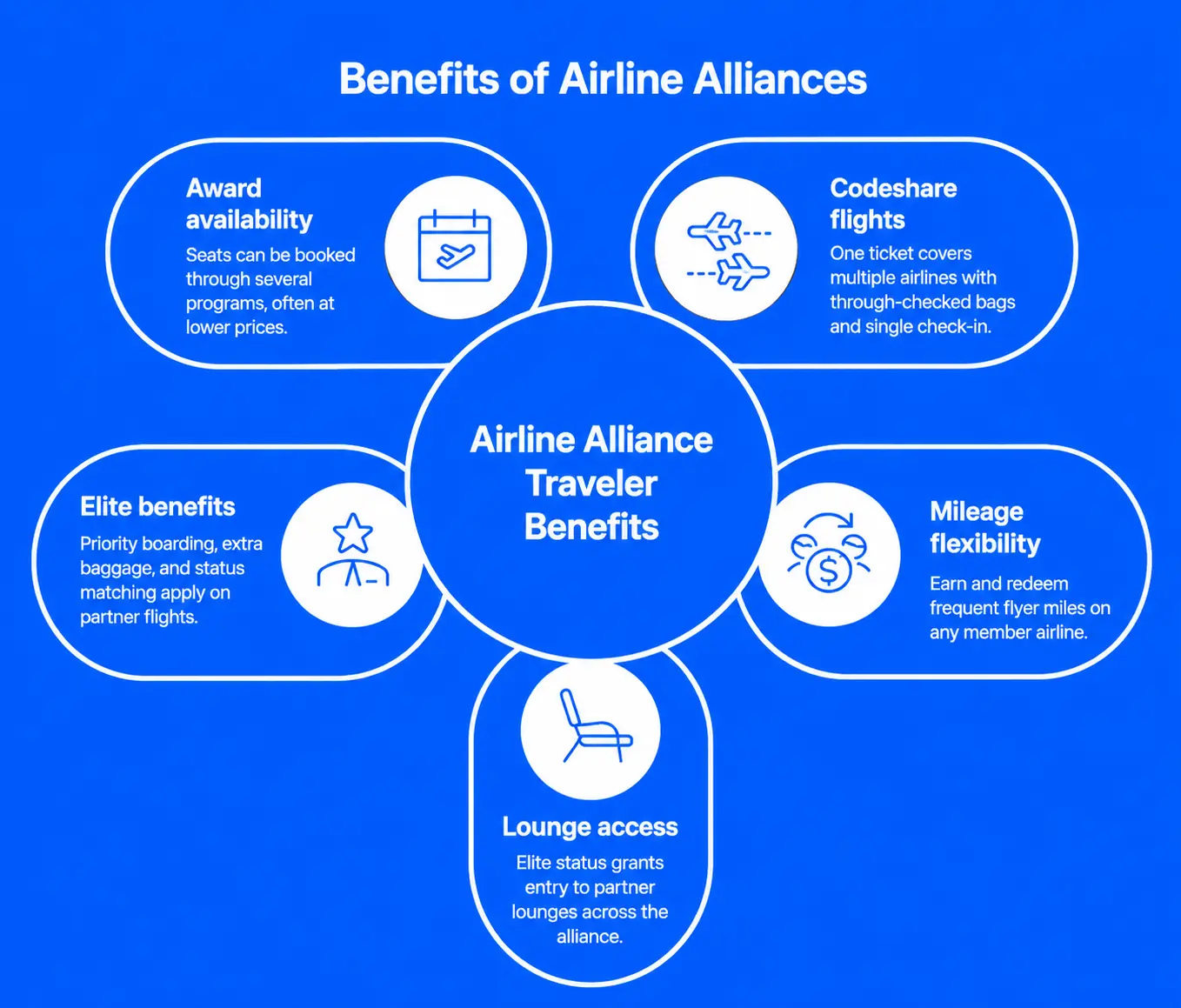
Here is what that cooperation actually gets you as a traveler:
- Codeshare flights: One ticket can cover multiple airlines, with your bags checked through and a single check-in desk for the whole journey.
- Mileage earning and redemption across partners: You earn and redeem frequent flyer program miles on any member airline, not just the one you fly most.
- Reciprocal lounge access: Elite status with one carrier opens partner lounges across the alliance when you fly member airlines.
- Elite status benefits: Priority boarding, extra baggage allowance, priority check-in, and tier status matching follow you onto partner flights.
- Partner award availability: The same seat can be booked through several programs, and one program often prices it far lower than another.
A quick distinction worth knowing: alliances are broad marketing networks, while deeper transatlantic joint ventures with antitrust immunity let specific carriers share revenue and schedules. That’s why some partner bookings inside an alliance deliver better value than others. Across all three alliances in 2026, members operate more than 60 airlines serving over 1,000 destinations each.

Star Alliance vs Oneworld vs SkyTeam: The 2026 Lineup
The three alliances split the globe differently, and 2026 brought real movement. ITA Airways joined Star Alliance in April, Hawaiian Airlines joined Oneworld the same month, and Korean Air’s absorption of Asiana reshapes Star Alliance’s Asian footprint by December. Size leads on coverage, but the smallest alliance often wins on cabin quality.
1. Star Alliance: Widest Reach
Star Alliance is the largest network in 2026, built for travelers who want to go almost anywhere on points.
- Key 2026 members: United, Lufthansa, Singapore Airlines, ANA, Air Canada, Turkish Airlines.
- Standout strength: 26 member airlines reaching more than 1,300 destinations, the broadest global coverage of any alliance.
- Best for: Complex multi-stop trips and hard-to-reach regions where partner options matter most.
- Programs to earn in: United MileagePlus and Air Canada Aeroplan, with Aeroplan offering some of the highest-value partner redemptions in 2026.
2. Oneworld: Premium and Points Strength
Oneworld is the smallest of the three, yet it consistently delivers the best premium-cabin products in the sky.
- Key 2026 members: American Airlines, British Airways, Qatar Airways, Cathay Pacific, Japan Airlines, Qantas.
- Standout strength: Flagship cabins like Qatar Qsuite, Japan Airlines First, and Cathay Business, plus semi-fixed award charts that protect value.
- Best for: Travelers chasing top-tier business and first class without dynamic pricing surprises.
- Programs to watch: AAdvantage and British Airways Avios, with Avios usable on Qatar Airways and beyond.
3. SkyTeam: Underrated Value
SkyTeam is the newest alliance and quietly one of the strongest for transatlantic flying and flexible redemptions.
- Key 2026 members: Delta, Air France, KLM, Korean Air, Virgin Atlantic, Aeromexico.
- Standout strength: Deep Delta-Air France-KLM-Virgin Atlantic coverage across the Atlantic, plus distance-based pricing on several partners.
- Best for: US-to-Europe routes and travelers who want predictable, off-peak award pricing.
- Programs to watch: Flying Blue and SkyMiles, with Flying Blue’s monthly Promo Rewards adding extra value.
Best Airline Alliance for Points and Premium Travel
The right alliance depends on what you optimize for. If you want the cheapest premium redemptions, Oneworld leads through Qatar and Japan Airlines. If you want raw destination count and partner depth, Star Alliance wins. If you fly the Atlantic often or want distance-based pricing that resists inflation, SkyTeam quietly outperforms its reputation.
Here is how the three compare on what actually decides value:
| Factor | Star Alliance | Oneworld | SkyTeam |
| Network reach | Widest (26 carriers) | Smallest (16 carriers) | Mid-size (18 carriers) |
| Premium cabin quality | Strong (Singapore Suites, ANA) | Best in class (Qsuite, JAL First) | Good (Delta One, Air France) |
| Award ticket booking ease | Mixed by program | Strong via fixed charts | Easy, distance-based |
| Best transfer programs | Aeroplan, ANA | Avios, AAdvantage | Flying Blue, Virgin Atlantic |
| Pricing model | Mostly fixed | Fixed or semi-fixed | Distance-based, off-peak |
The trade-off is real. The widest network is not the cheapest redemption, and the best cabins sit inside the smallest alliance. Star Alliance can price premium partner seats high through some programs. Oneworld’s smaller footprint means fewer routes to secondary cities. SkyTeam’s dynamic pricing on Delta-operated metal can sting unless you book through Virgin Atlantic or Flying Blue instead.
How to Pick the Right Alliance for You
Forget chasing a universal “best.” The alliance that fits you depends on your home airport, your routes, and the points you already earn. Start there and the choice gets simple.
Work through these three questions in order:
- Where do you fly most? Map your home airport and top routes to the alliance with the strongest coverage there, since your nearest hub carrier is only the right answer if it serves your destinations.
- Which transfer currency do you hold? Chase leans Star Alliance and Oneworld, Amex spans all three, and Capital One and Citi open Flying Blue and Avios, so let your existing points guide the pick.
- What cabin and trip type matter? Premium-cabin dreams point to Oneworld, round-the-world tickets favor Star Alliance’s breadth, and transatlantic regulars lean SkyTeam.
Skip the Guesswork With Flightpoints
You now know which alliance suits your routes, but finding the actual award seat across all three is where most travelers stall. Award space on premium cabins like ANA, Cathay, and Singapore moves fast, and checking each program by hand eats hours. Flightpoints closes that gap by searching award availability across more than 25 loyalty programs at once.
Here is what that does for your booking:
- Surfaces real seats across alliances: Compare Star Alliance, Oneworld, and SkyTeam award availability from one search instead of ten browser tabs.
- Shows the cheapest transfer path: See where your Chase, Amex, or Capital One points convert into a premium seat for the fewest miles before you transfer anything.
- Flags availability before it vanishes: Set alerts so you catch a seat the moment it opens rather than after it’s gone.
The villain here isn’t the alliances. It’s the credit card portal that quietly charges you two to four times more points than a smart partner booking. Seeing the partner option side by side is what keeps those points in your account.
The Bottom Line
The best airline alliance in 2026 isn’t a single trophy winner. It’s the one matched to your routes and your points. Star Alliance gives you the widest reach, Oneworld gives you the best premium cabins, and SkyTeam gives you strong transatlantic coverage with pricing that resists inflation. Each one rewards a different kind of traveler, and the smart move is picking the alliance your habits already point toward.
So before your next big trip, ask yourself: which alliance is your points balance really built for? Answer that honestly, and the booking gets a lot easier. Ready to turn that answer into a booked seat? Get Flightpoints Pro and search live award availability across Star Alliance, Oneworld, and SkyTeam from one place, so you find the premium seat you want for the fewest points.
Find Your Best Award Flight in Seconds
Search live award availability across Star Alliance, oneworld, and SkyTeam from one place—and book the premium seat you want using the fewest points.
Get FlightPoints Pro →FAQs
Q: Which airline alliance is the largest in 2026?
A: Star Alliance is the largest airline alliance in 2026. It includes 26 member airlines, serves more than 1,150 destinations worldwide, and operates over 19,000 daily flights. Its extensive network makes it the strongest alliance for travelers seeking broad global connectivity and award flight options.
Q: Can I use miles from one airline to book flights on another airline in the same alliance?
A: Yes. One of the main benefits of major airline alliances is reciprocal redemption. For example, you can use United MileagePlus miles to book flights operated by Lufthansa or ANA through Star Alliance. Similarly, British Airways Avios can often be used on Qatar Airways and Japan Airlines within Oneworld.
Q: Which airline alliance is best for award travel?
A: The answer depends on your travel goals. Star Alliance generally offers the most destinations and partner options, while Oneworld is known for premium redemptions such as Qatar Qsuite and Japan Airlines First Class. SkyTeam provides strong transatlantic coverage and valuable Flying Blue redemption opportunities.
Q: How can I compare award flights across different airline alliances?
A: Comparing alliance award availability manually requires searching multiple airline loyalty programs individually. Flightpoints simplifies the process by searching award space across more than 25 loyalty programs simultaneously, allowing travelers to compare Star Alliance, Oneworld, and SkyTeam redemption options from one place.
Q: Do airline alliance benefits include lounge access?
A: Yes. Most alliance elite status tiers include reciprocal lounge access when traveling on member airlines. Benefits may also include priority boarding, extra baggage allowances, priority check-in, and expedited airport services depending on your status level and itinerary.
Q: Which airline alliance has the best premium cabin products in 2026?
A: Oneworld is often considered the strongest alliance for premium cabin experiences because it includes products such as Qatar Airways Qsuite, Japan Airlines First Class, and Cathay Pacific Business Class. However, Star Alliance also offers highly regarded products like Singapore Suites, ANA The Room, and Lufthansa First Class.
Q: Are airline alliances changing in 2026?
A: Yes. Several alliance changes are reshaping the industry in 2026. ITA Airways joined Star Alliance, Hawaiian Airlines joined Oneworld, and the Korean Air–Asiana merger is expected to strengthen SkyTeam’s position in Asia. These developments affect route networks, loyalty benefits, and award redemption opportunities.
Q: How do major airline alliances affect credit card points transfers?
A: Airline alliances expand the number of ways travelers can use transferred credit card points. Instead of redeeming through a single airline, travelers can transfer points to partner loyalty programs and access a much larger network of alliance-operated flights, often unlocking better redemption value.