Table of Contents
Every alliance markets itself as the environmentally responsible choice, and the language rarely helps you compare anything. One airline talks about carbon removals, another talks about sustainable aviation fuel, and a third talks about net zero pledges dated decades out. None of it tells you which alliance is actually doing more.
Discover the True Value of Your Points
Ready to see what your points are really worth? Get Flightpoints Pro and find the cheapest award seat across every program in seconds.
Get Flightpoints ProSo which alliance should you trust if sustainability factors into your travel decisions? And does picking the most sustainable airline alliance even change anything about how you redeem your points? In this article, we break down how Star Alliance, oneworld, and SkyTeam compare on fuel investment, carbon offsetting, and long-term climate goals, so you can judge the claims instead of taking them at face value.
TL;DR
- Alliances do not set sustainability policy directly. Member airlines do, which means your actual carrier matters more than the alliance badge.
- Sustainable aviation fuel (SAF) investment varies widely within each alliance, not just between them.
- Carbon offset programs are not a substitute for emissions reduction, and the distinction matters when you evaluate a claim.
- No alliance is uniformly ahead on every metric, so your redemption choice should depend on the specific airline operating your flight.
- FlightPoints lets you compare redemption paths across alliances without researching each airline’s sustainability page separately.
Most Sustainable Airline Alliances: How Airline Alliances Approach
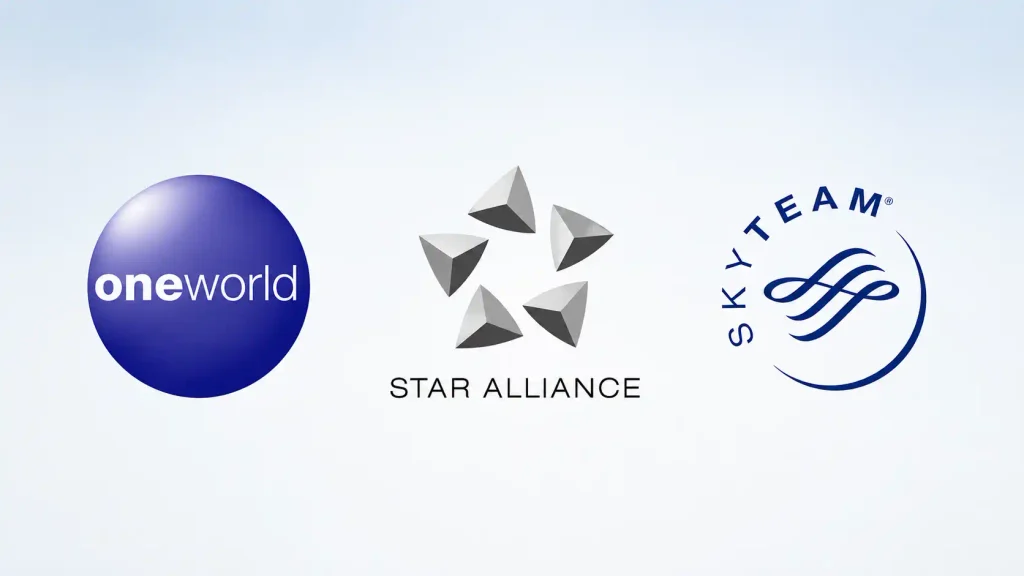
Star Alliance, oneworld, and SkyTeam do not set fuel policy or emissions targets for their members. Each is a coordination framework that lets airlines share routes, lounges, and loyalty benefits. Sustainability commitments come from individual carriers, not the alliance itself.
This distinction changes how you should read alliance-level marketing. A oneworld ad about sustainability reflects whichever member airline wrote it, not a shared oneworld policy. The same applies to Star Alliance and SkyTeam. Identifying the most sustainable airline alliance means comparing the average commitment level of each alliance’s most influential member airlines.
That is the lens we use through the rest of this comparison.
Sustainable Aviation Fuel (SAF) Commitments by Airline Alliance
SAF is the single largest lever the industry has for cutting emissions. According to IATA, SAF is expected to deliver up to 65% of the emissions reductions aviation needs to reach net zero by 2050. That makes SAF investment the clearest signal of which airlines are serious.
Here is how the major carriers in each alliance compare on SAF activity:
| Alliance | Leading Carriers on SAF | Notable Activity |
|---|---|---|
| Star Alliance | Lufthansa, United, ANA | Lufthansa Cargo has added SAF surcharges to fund blending; United has multiple SAF offtake agreements |
| oneworld | British Airways, American Airlines | American signed a large SAF certificate deal with Google in 2026, covering 35 million gallons over three years |
| SkyTeam | Air France-KLM, Delta | Delta has reaffirmed a 10% SAF usage target by 2030 despite supply pressure |
A few things stand out from this table:
- SAF supply remains under 1% of global jet fuel use industry-wide, so even leading airlines are working from a small base.
- Regulatory mandates, like the EU’s ReFuelEU rule requiring 2% SAF by 2025 rising toward 70% by 2050, apply across alliances equally. No alliance gets a regulatory head start.
- The gap between airlines within the same alliance is often larger than the gap between alliances, making it difficult to name the most sustainable airline alliance based on SAF activity alone.
Airline Carbon Offset Programs Comparison
Offsetting and reducing emissions are not the same thing, and conflating them is where a lot of sustainability marketing gets misleading. Reduction means burning less carbon. Offsetting means paying someone else to remove or avoid carbon elsewhere.
Most international flights already fall under CORSIA, the global offsetting scheme run by ICAO. Compliance costs are rising industry-wide, from roughly $1.3 billion in 2025 to an estimated $1.7 billion in 2026. That cost applies to any airline flying international routes, regardless of alliance.
Beyond CORSIA’s baseline requirement, some carriers run voluntary carbon removal programs:
- British Airways (oneworld) expects carbon removals to account for about one-third of its total emissions reductions by 2050, using both nature-based and engineered removal methods.
- Air France-KLM (SkyTeam) offers passenger-facing voluntary offset options tied to SAF book-and-claim purchases.
- Star Alliance carriers rely more heavily on CORSIA compliance than on branded voluntary removal programs, though this varies by member.
The practical takeaway: a carrier that leans on offsets while making limited SAF or fleet investment is not necessarily more sustainable than one with fewer offset headlines but a stronger fuel and efficiency record.
Star Alliance vs oneworld vs SkyTeam: Environmental Impact Compared
Zooming out from individual programs, here is how the three alliances stack up across the factors that actually affect emissions:
| Factor | Star Alliance | oneworld | SkyTeam |
|---|---|---|---|
| Network size | Largest, broadest global reach | Smallest of the three, more concentrated | Mid-sized, strong North America and Europe focus |
| SAF investment leadership | Strong from Lufthansa and United | Strong from American and British Airways | Strong from Air France-KLM, mixed elsewhere |
| Offset program maturity | CORSIA-focused, fewer branded programs | More developed voluntary carbon removal programs | Growing, tied to SAF book-and-claim |
| Fleet modernization pace | Mixed, varies significantly by carrier | Generally newer premium fleets | Mixed, some older widebody fleets remain |
None of the three alliances leads across every category. A larger network moves more passengers per flight on average, which can improve per-passenger efficiency even without new technology. A smaller, premium-focused network like oneworld can invest more per aircraft in newer fleets. Neither structural advantage means the alliance is doing more for the climate; it just changes where the efficiency comes from.
This is also why choosing the most sustainable airline alliance based on branding alone rarely works. The airline operating your specific flight matters more than the branding on the tail.
Net Zero Aviation by 2050: Where Each Alliance Stands
The industry-wide target, set through IATA, is net zero carbon emissions by 2050. Every major carrier across all three alliances has formally committed to this goal, so the target itself does not differentiate them. What differs is the credibility of the roadmap behind it.
Airlines with credible 2050 pathways typically show:
- Specific interim targets, not just a 2050 endpoint
- Signed SAF offtake agreements with named volumes and dates
- Public reporting on fleet efficiency gains year over year
- Transparent breakdowns of how much of the goal relies on offsets versus actual reduction
Carriers still leaning heavily on aspirational language without interim milestones are harder to evaluate, regardless of which alliance they belong to. If you want a signal that separates real commitment from marketing, check whether an airline discloses its offset-to-reduction ratio. Airlines that hide this number usually have less to show.
Does Alliance Sustainability Affect Your Redemption Value?
For a points traveler, sustainability differences rarely change the number of miles a seat costs. What it can change is which specific redemption you choose when two options are otherwise similar in value.
If you are deciding between a Star Alliance partner seat and a oneworld seat priced at comparable miles, the sustainability comparison above gives you a tiebreaker. It will not override a large gap in redemption value, but it can settle a close call.
This only works if you can see both options side by side. Manually checking SAF pages and offset disclosures for every airline before every booking is not realistic, especially when award availability changes fast.
Finding the Most Sustainable Redemption Without the Guesswork

Comparing sustainability claims across three alliances and dozens of member airlines takes real research time, and most of that research has to be redone every time policies are updated. Meanwhile, award seats do not wait.
Flightpoints simplifies the redemption side of this decision. Instead of checking each loyalty program manually, you can compare award availability and pricing across Star Alliance, Oneworld, and SkyTeam partners in one place.
- Explore helps you see redemption options across alliances at once, so a sustainability tiebreaker is easy to apply once you know it.
- Routes show how a routing decision, like connecting through one partner versus another, changes both your points cost and your carrier mix.
- Alerts flag award availability changes, so you are not stuck choosing the only visible option when a better-aligned one opens up later.
The sustainability research still matters. FlightPoints just removes the redemption-side guesswork once you have decided what matters to you.
Conclusion
There is no clear most sustainable airline alliance across every metric. Star Alliance, oneworld, and SkyTeam each have member airlines leading in SAF, offsetting, or fleet efficiency, and the strongest performer within each alliance often outpaces the alliance’s own average. The mistake to avoid is trusting alliance-level marketing over airline-specific data when it actually matters to your decision.
If sustainability is a genuine factor in how you choose flights, the more useful question is not “which alliance is greenest,” but “which specific airline on this route has the stronger record.” That question is answerable, and the comparisons above give you a starting framework for asking it.
Once you know which airline or alliance fits your priorities, Flightpoints can help you find the strongest redemption path to get there.
FAQs
Q: Which airline is the most sustainable?
A: No single airline holds a universal title, since programs report progress on different metrics and timelines. British Airways, American Airlines, and Air France-KLM are cited most often for strong SAF or carbon removal programs, but the best choice depends on the route and metric you prioritize.
Q: Is SkyTeam better than Star Alliance for sustainability?
A: Neither wins outright. Star Alliance has a larger network and strong SAF activity from Lufthansa and United, while SkyTeam’s lead comes mainly from Air France-KLM. The stronger choice depends on which specific carrier operates your route, not the alliance badge itself.
Q: Is oneworld or Star Alliance more sustainable?
A: oneworld tends to lead on newer, more fuel-efficient fleets and voluntary carbon removal programs, largely through British Airways. Star Alliance leads on scale and SAF offtake volume through Lufthansa and United. Both trail behind on actual SAF supply relative to total fuel use.
Q: What are the top 3 airline alliances, and are any more sustainable than the others?
A: Star Alliance, oneworld, and SkyTeam are the three major global alliances. None leads consistently across every sustainability metric, since alliances set no shared policy. Compare specific member airlines instead of ranking alliances as a whole.
Q: Does flying a more sustainable airline alliance cost more points?
A: No. Award pricing follows the loyalty program’s chart and current availability, not the airline’s sustainability record. A SAF-forward carrier and a less advanced one can price the same route almost identically in miles.
Q: Are voluntary carbon offsets worth paying for on award flights?
A: Offsets fund real projects but do not reduce emissions from your specific flight. Treat them as a separate contribution rather than a way to lower your redemption’s impact. If reduction matters more to you, prioritize airlines with strong SAF usage instead.