
Table of Contents
The honest answer is: it depends on the airline, route, cabin, travel date, and award availability. A short domestic flight might cost as little as 4,500 to 10,000 miles one-way, while an international economy flight can easily cost 25,000 to 65,000 miles one-way. Business class and first class awards can require 60,000 to 150,000+ miles each way.
But there is one important thing to understand before anything else: award flights are usually not completely free. Miles or points normally cover the base fare, but you still pay taxes, airport fees, government charges, and sometimes carrier-imposed surcharges. For U.S. domestic flights, the cash cost can start around $5.60 one-way. For international flights, the taxes and fees can range from modest to several hundred dollars depending on the airline and route.
So when travelers ask, “How many miles do you need for a free flight?” the better question is: “How many miles do I need for the route I want, and is using miles better than paying cash?”
This guide explains the realistic number of miles needed for free flights in 2026, including domestic trips, international economy awards, Hawaii, Europe, Asia, business class, airline-specific examples, and how Flightpoints can help you find the lowest bookable award seats.
Quick Summary
- Most “free flights” are award flights where miles cover the base fare, but taxes and fees still apply.
- Short domestic one-way flights can start around 4,500 to 10,000 miles or points, depending on the airline program.
- Standard domestic economy flights in the U.S. often cost around 7,500 to 25,000 miles one-way, though dynamic programs can price higher during busy dates.
- Round-trip domestic flights commonly require around 15,000 to 50,000 miles in economy.
- Flights from the U.S. to Europe usually need around 20,000 to 45,000 miles one-way in economy when saver or promo space is available.
- Flights from North America to Asia often require around 30,000 to 65,000 miles one-way in economy, depending on the program and distance.
- Business class awards are much more expensive, often starting around 60,000 to 90,000 miles one-way for long-haul routes and rising above 100,000 miles in many programs.
- Airlines like Southwest, JetBlue, Delta, and United use dynamic pricing, so there is no single fixed mileage number.
- Programs like American AAdvantage, Air Canada Aeroplan, British Airways Avios, Alaska/Atmos, and Emirates Skywards publish starting prices, charts, calculators, or route-based pricing that can help estimate the number of miles needed.
- Always compare the miles price with the cash fare before booking. A cheap cash ticket may not be worth using miles for.
How Many Miles Do You Need for a Free Flight? The Practical Answer
For most travelers, a realistic starting point is:
| Flight Type | Typical One-Way Miles Needed | Typical Round-Trip Miles Needed |
|---|---|---|
| Very Short Domestic Flight | 4,500–10,000 miles | 9,000–20,000 miles |
| Standard Domestic Economy Flight | 7,500–25,000 miles | 15,000–50,000 miles |
| U.S. to Mexico / Caribbean | 10,000–30,000 miles | 20,000–60,000 miles |
| U.S. West Coast to Hawaii | 12,500–40,000 miles | 25,000–80,000 miles |
| North America → Europe (Economy) | 18,750–45,000 miles | 37,500–90,000 miles |
| North America → Asia (Economy) | 30,000–65,000 miles | 60,000–130,000 miles |
| Long-Haul Business Class | 60,000–110,000 miles | 120,000–220,000 miles |
| Long-Haul First Class | 90,000–150,000+ miles | 180,000–300,000+ miles |
These are practical planning ranges, not guaranteed prices. The actual miles needed can be lower during promotions or much higher when airlines use dynamic pricing.
For example, a short American Airlines flight may start at 7,500 AAdvantage miles one-way, while a Southwest or JetBlue flight may price based on the cash fare. If the cash ticket is cheap, the points price may be low. If the cash ticket is expensive, the points price usually rises too.
The key takeaway: you can sometimes book a free flight with under 10,000 miles, but for most useful trips, you should expect to need at least 15,000 to 30,000 miles for a domestic round trip and 40,000 to 90,000 miles for an international economy round trip.
Why There Is No Single Mileage Number for a Free Flight
There used to be a time when many airline programs had simple award charts. You could look at a chart and know that a domestic flight cost a fixed number of miles. Today, many major airlines use dynamic pricing.
Dynamic pricing means the miles price can change based on:
- Route
- Travel date
- Cash fare
- Demand
- Seat availability
- Cabin class
- Airline program
- Whether the flight is operated by the airline or a partner
- How close you are to departure
That is why two people can search the same route and see very different mileage prices. A Tuesday flight in September may cost 9,000 miles, while a Friday flight before Christmas may cost 45,000 miles for the same route.
There are still programs with published starting prices or award charts, but even those often say “starting at.” That means the lowest price only appears when the right award space is available.
This is why award travel is not just about collecting miles. It is about knowing when and where to search.
How Many Miles Do You Need for a Free Domestic Flight?
For U.S. domestic flights, you can often book a one-way award starting around 5,000 to 12,500 miles if you are flexible. More commonly, domestic economy awards cost around 7,500 to 25,000 miles one-way.
Here are some real program patterns:
- American Airlines says flight awards on American-operated flights can start from 7,500 miles each way, plus applicable taxes and fees.
- Southwest Rapid Rewards does not use a fixed award chart. Instead, points are tied closely to the cash fare. If a seat is available, you can use points for it, and there are no blackout dates.
- JetBlue TrueBlue also lets members redeem points for JetBlue flights with no blackout dates, and the points price usually follows the cash price.
- Delta SkyMiles has no blackout dates on Delta-operated flights, but award prices are dynamic. A domestic flight can be cheap on one day and expensive on another.
- United MileagePlus also uses dynamic pricing for many awards, so the number of miles needed depends on the exact flight and date.
A realistic planning target for domestic flights:
| Domestic Trip Type | Good Target |
|---|---|
| Short One-Way Flight | 5,000–10,000 miles |
| Normal One-Way Flight | 7,500–20,000 miles |
| Expensive Peak-Date One-Way | 25,000+ miles |
| Normal Round Trip | 15,000–40,000 miles |
| Peak Round Trip | 50,000+ miles |
Best strategy: search flexible dates and compare multiple programs. If the cash fare is only $120 round trip, paying cash may be better. If the cash fare is $500 and the award is 20,000 miles plus low taxes, using miles can be a strong deal.
How Many Miles Do You Need for a Free Flight to Hawaii?
Hawaii pricing varies a lot because some programs price by distance, while others price dynamically.
A realistic economy range from the U.S. mainland to Hawaii is around 12,500 to 40,000 miles one-way. Round trip, that means around 25,000 to 80,000 miles.
West Coast flights to Hawaii are usually the best deal because the distance is shorter and the cash fares can be high during holidays. Programs with distance-based pricing may price West Coast–Hawaii awards better than East Coast–Hawaii awards.
For example, if you can find a West Coast–Hawaii economy award around 12,500 to 15,000 miles one-way, that is generally a strong result. If the award price is 35,000 or 40,000 miles one-way in economy, compare the cash fare carefully before booking.
For Hawaii, always check:
- Los Angeles
- San Francisco
- Seattle
- San Diego
- Portland
- Honolulu
- Maui
- Kona
- Kauai
If your home airport does not show good availability, it may be cheaper to position to a West Coast gateway and book the Hawaii award separately.
How Many Miles Do You Need for a Free Flight to Europe?
For North America to Europe, economy awards usually need around 20,000 to 45,000 miles one-way when saver or promo space is available. Round trip, a realistic planning range is around 40,000 to 90,000 miles.
Some of the best Europe awards come from programs like Flying Blue, Air Canada Aeroplan, British Airways Avios, American AAdvantage, Virgin Atlantic, and United MileagePlus.
Flying Blue can be very useful for Europe because Air France and KLM regularly release Promo Rewards. These monthly offers can reduce the miles needed on select routes. When a North America–Europe economy Promo Reward is available, it can sometimes bring pricing below the normal level.
Aeroplan uses a distance-based zone chart. After its June 2026 chart update, North America to Atlantic-zone awards in the shortest band start from 32,500 points one-way in economy. Longer distances and partner combinations can price higher.
British Airways Avios can be useful for flights to and within Europe, but taxes and carrier charges matter. British Airways reward flights use a fixed Avios amount plus a fixed cash amount on many BA-operated flights, and the cash part can be higher on long-haul routes.
For Europe, a good planning table is:
| Europe Trip Type | Economy One-Way Target | Economy Round-Trip Target |
|---|---|---|
| Promo or Saver Deal | 18,750–25,000 miles | 37,500–50,000 miles |
| Normal Saver Award | 30,000–45,000 miles | 60,000–90,000 miles |
| Dynamic Peak Date | 50,000+ miles | 100,000+ miles |
Best strategy: search multiple gateways. New York, Boston, Washington, Chicago, Atlanta, Miami, Toronto, and Montreal often have more Europe award options than smaller airports.
How Many Miles Do You Need for a Free Flight to Asia?
North America to Asia usually requires more miles because the flights are longer. In economy, a realistic one-way range is around 30,000 to 65,000 miles. Round trip, plan for around 60,000 to 130,000 miles.
The exact number depends heavily on the program and destination.
Japan and Korea may price lower than Southeast Asia in distance-based programs because the total distance is shorter. Flights to Singapore, Thailand, Malaysia, Indonesia, and the Philippines may cost more, especially if your itinerary includes connections.
For example:
West Coast to Japan may price around 30,000 to 40,000 miles one-way in economy in some partner programs. Central or East Coast U.S. to Japan may price higher because the distance is longer.
North America to Southeast Asia often falls into higher distance bands and can require 40,000 to 65,000 miles one-way in economy.
Business class to Asia often starts around 75,000 to 110,000 miles one-way and can go much higher in dynamic programs.
For Asia, award availability matters more than the chart. Airlines like Japan Airlines, ANA, EVA Air, Singapore Airlines, Cathay Pacific, Korean Air, and Qatar Airways may release partner award seats, but availability can be limited during holidays and school breaks.
Best strategy: search early, search one-way, and check several gateway airports. Los Angeles, San Francisco, Seattle, Vancouver, Chicago, Dallas, New York, and Toronto can all be useful depending on the airline.
How Many Miles Do You Need for a Free Business Class Flight?
Business class is where miles can give huge value, but it also requires far more miles than economy.
For long-haul business class, you should usually expect:
| Business Class Route Type | Typical One-Way Miles Needed |
|---|---|
| U.S. Domestic Short Route | 15,000–40,000 miles |
| U.S. Transcontinental | 25,000–75,000 miles |
| North America → Europe | 45,000–90,000 miles |
| North America → Asia | 60,000–110,000 miles |
| North America → Middle East / India | 70,000–120,000 miles |
| Ultra-Long-Haul Premium Awards | 100,000+ miles |
The best business class awards are usually found through partner programs with award charts or distance-based pricing. But they are also harder to find because airlines release fewer premium seats.
If you want business class, the most important rule is to be flexible. Search multiple dates, multiple airports, and multiple programs. A business class seat that is impossible from your home airport may be available from a nearby hub.
For example, instead of searching only Atlanta to Paris, also search New York to Paris, Boston to Amsterdam, Washington to Paris, or Montreal to Paris. Then decide whether a short positioning flight is worth it.
How Many Miles Do You Need for a Free First Class Flight?
First class awards are the most expensive and the hardest to find. Many airlines have reduced or removed international first class cabins, and those that still offer them often release very few award seats.
For international first class, expect one-way pricing around 90,000 to 150,000+ miles. Some dynamic programs may charge far more.
First class awards are usually best for travelers who:
- Have a large points balance
- Are very flexible with dates
- Can position to another airport
- Understand partner award searches
- Are willing to book quickly when space appears
If you are new to points, economy and business class awards are usually more practical. First class is a great goal, but it is not the easiest “free flight” to book.
Airline-by-Airline Examples: How Many Miles Do You Need?
Here is a simple breakdown of how major programs approach award pricing.
| Program | How Pricing Works | Useful Starting Point |
|---|---|---|
| American AAdvantage | Published starting prices with dynamic variation | American-operated flights can start from 7,500 miles one-way. |
| Southwest Rapid Rewards | Cash-price-linked dynamic pricing | No fixed number; any available seat can be booked with points. |
| JetBlue TrueBlue | Cash-price-linked dynamic pricing | No fixed number; points can be redeemed for JetBlue-operated flights. |
| Delta SkyMiles | Dynamic pricing | No published award chart and no blackout dates on Delta flights. |
| United MileagePlus | Dynamic pricing | No fixed public award chart for United-operated flights. |
| Air Canada Aeroplan | Zone and distance-based award chart | North America–Atlantic economy starts from 32,500 points in the shortest distance band. |
| British Airways Avios | Distance-based pricing with Reward Flight Saver options | Reward flights can start from 10,000 Avios + £1 each way. |
| Emirates Skywards | Route-based calculator and Classic Rewards | Classic Rewards start from 5,000 miles, excluding taxes and fees. |
| Qatar Privilege Club | Avios calculator with award availability pricing | Use Qatar’s Avios calculator to determine the exact points required. |
This table shows why there is no universal answer. One program might show 12,000 points for a domestic route while another shows 25,000 miles for the same date. That is why comparing programs is important.
Taxes and Fees: Why a “Free Flight” Still Costs Money
A free flight with miles is not usually 100% free. You still pay some cash.
Common cash charges include:
- Government taxes
- Airport fees
- Security fees
- International arrival or departure taxes
- Carrier-imposed surcharges
- Partner booking fees
- Close-in or service fees in some programs
For U.S. domestic awards, the cash cost is often low. For example, many U.S. one-way awards start from $5.60 in taxes and fees. But international flights can be very different.
A British Airways long-haul award may require a large cash payment because of taxes, fees, and carrier charges. Some Emirates and Qatar awards also include taxes and carrier-imposed fees. On the other hand, some programs and partner combinations keep fees lower.
Always check the final payment screen. A flight that costs 30,000 miles plus $30 is very different from a flight that costs 30,000 miles plus $450.
How to Know If Using Miles Is Worth It
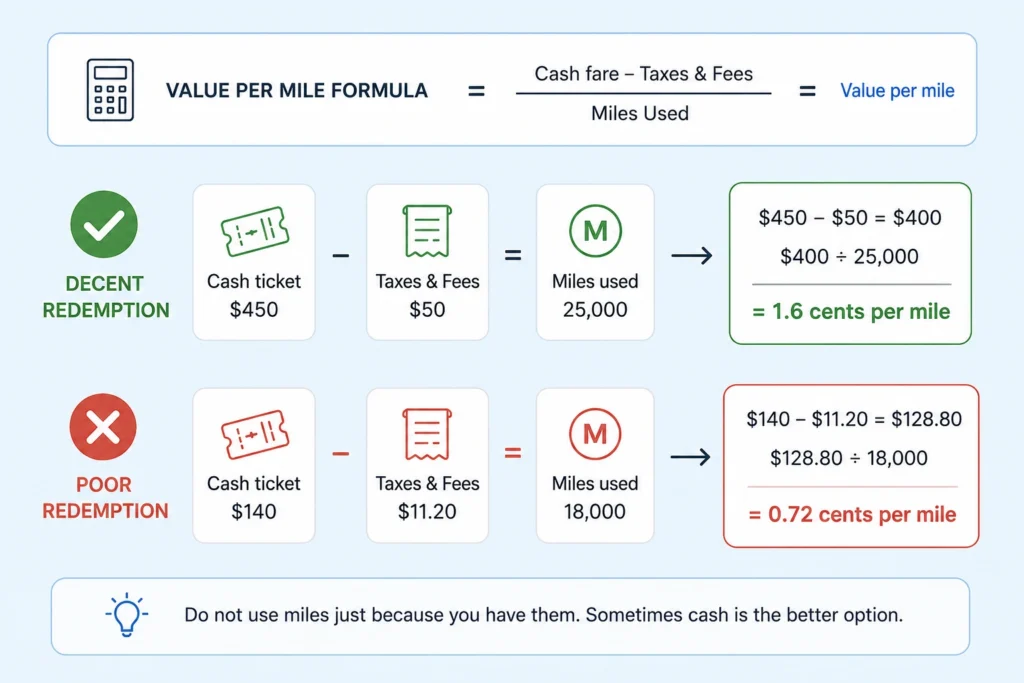
That is usually not a great use of miles. You may be better off paying cash and saving miles for a more expensive trip.
How to Reduce the Number of Miles Needed
- Use flexible dates. One day can change the price by thousands of miles.
- Search nearby airports. A nearby hub may have cheaper award space.
- Book early for partner awards. Many airlines release seats around 11 months before departure.
- Also check close-in availability. Some airlines release unsold seats shortly before departure.
- Use transfer bonuses. A 20% or 30% transfer bonus can reduce the real number of credit card points needed.
- Avoid peak dates. Holidays, school breaks, and major events usually require more miles.
- Compare programs before transferring. The same flight may be available through different programs at different prices.
- Set alerts. Availability changes. Alerts can catch seats when they open.
How Flightpoints Helps You Find Free Flights With Miles
The biggest problem is not knowing the average number of miles needed. The biggest problem is finding actual bookable award seats.
Flightpoints helps by showing award availability across multiple programs, routes, cabins, and dates. Instead of checking every airline website one by one, you can search in one place and compare options.
Flightpoints can help you:
- Find the lowest points price for your route
- Compare airline programs
- Search economy, premium economy, business, and first class
- Track routes with alerts
- See when award seats open
- Avoid transferring points before confirming availability
- Compare cash fares against points prices
For example, if you want to fly New York to Paris, Flightpoints can help compare Flying Blue, United, Air Canada Aeroplan, American, British Airways, Virgin Atlantic, and other possible options. If you want to fly Los Angeles to Tokyo, you can search for availability across Japan Airlines, American, Alaska/Atmos, United, Aeroplan, and other programs.
The number of miles needed matters. But availability matters more. A 25,000-mile award is only useful if you can actually book it.
Conclusion
So, how many miles do you need for a free flight? For domestic flights, you may need as little as 4,500 to 10,000 miles one-way, but 7,500 to 25,000 miles is a more realistic range for many routes. For international economy flights, expect around 20,000 to 65,000 miles one-way. For business class, plan for 60,000 to 110,000+ miles one-way on long-haul routes.
The exact number depends on the airline, route, cabin, date, demand, and award availability. Dynamic pricing means many airlines no longer have one fixed answer. Published award charts and starting prices are useful, but the final price is always the one you see when you search.
The smartest strategy is simple: compare programs, search flexible dates, check taxes and fees, calculate the value, and book only when the redemption makes sense. Flightpoints helps you find award seats faster, compare mileage prices, and set alerts so you do not miss the lowest bookable awards.
Discover the True Value of Your Points
Ready to see what your points are really worth? Get Flightpoints Pro and find the cheapest award seat across every program in seconds.
Get Flightpoints ProFAQs
Q: How many miles do you need for a free flight?
A: For a short domestic flight, you may need as few as 4,500 to 10,000 miles one-way. For a standard domestic round trip, expect around 15,000 to 50,000 miles. For international economy flights, plan for around 40,000 to 130,000 miles round trip depending on the route.
Q: Are flights booked with miles really free?
A: Not completely. Miles usually cover the base fare, but you still pay taxes, fees, and sometimes carrier-imposed surcharges. Domestic U.S. awards often have low cash costs, while international awards can have higher fees.
Q: How many miles do I need for a domestic free flight?
A: Most domestic economy awards cost around 7,500 to 25,000 miles one-way, though short flights can be cheaper and peak dates can be higher.
Q: How many miles do I need for a free international flight?
A: For international economy, a realistic range is 20,000 to 65,000 miles one-way. Europe is often on the lower end, while Asia, Australia, and long connecting itineraries can require more.
Q: How many miles do I need for a free flight to Europe?
A: North America to Europe usually costs around 20,000 to 45,000 miles one-way in economy when saver or promo availability exists. Business class is often around 45,000 to 90,000 miles one-way.
Q: How many miles do I need for a free business class flight?
A: Long-haul business class usually requires around 60,000 to 110,000 miles one-way. Some programs price lower during promotions, while dynamic programs can charge much more.
Q: Is it better to use miles or pay cash?
A: Use miles when the cash fare is high and the award price is reasonable. Pay cash when the fare is cheap or when the award requires too many miles plus high fees.
Q: Should I transfer credit card points before searching?
A: No. Always confirm award availability first. Most transfers to airline programs cannot be reversed.