
Table of Contents
The Cathay Pacific oneworld multi carrier award is one of the most flexible ways to use Asia Miles for a complex international trip. Instead of redeeming miles separately for every flight, you can combine multiple oneworld airlines into one award itinerary. Pricing is based on the total distance flown across the entire itinerary, with up to five stopovers, two transfers, and two open jaws permitted under the current rules.
That creates opportunities for multi-country trips using airlines such as Japan Airlines, Qatar Airways, Qantas, British Airways, American Airlines, Cathay Pacific, and other oneworld carriers.
But there is a catch: not every multi-airline itinerary qualifies.
The number of airlines, whether Cathay Pacific is included, total distance, cabin class, and routing all matter. Building the itinerary also requires much more planning than booking a simple one-way award.

What Is a Cathay Pacific oneworld Multi-Carrier Award?
A Cathay Pacific oneworld multi carrier award is an Asia Miles redemption that combines several oneworld airlines under a special distance-based award chart.
Under Cathay’s current 2026 rules, the itinerary qualifies in one of two ways:
- Two oneworld airlines when Cathay Pacific is not one of the airlines.
- Three or more oneworld airlines when Cathay Pacific is included.
The total itinerary can cover up to 50,000 flown miles. This distinction is important.
For example:
- Japan Airlines + American Airlines
This can qualify because you are using two oneworld airlines without Cathay Pacific.
- Cathay Pacific + Japan Airlines
This does not qualify as a oneworld Multi-Carrier Award because Cathay is included but only two airlines are being used.
- Cathay Pacific + Japan Airlines + Qantas
This can qualify because Cathay is included along with at least two other oneworld airlines. That airline-count rule is one of the first things to check before calculating your mileage cost.
How Is the Award Price Calculated?
The Cathay Pacific oneworld multi carrier award uses the total distance flown across every flight segment. Cathay calculates the distance of each sector and adds them together. The total determines which award-chart band applies.
Imagine an itinerary with four flights:
- Flight 1: 3,000 miles
- Flight 2: 5,000 miles
- Flight 3: 4,500 miles
- Flight 4: 6,000 miles
Total flown distance:
18,500 miles
You would therefore use the 18,001-20,000-mile band on the multi-carrier award chart. This differs from many normal award tickets where each one-way journey or individual segment may be priced separately. The ability to price an entire multi-stop journey according to cumulative distance is what makes this award particularly interesting.
Cathay Pacific oneworld Multi-Carrier Award Chart
The current 2026 pricing is:
| Total Distance Flown | Economy | Business | First |
|---|---|---|---|
| 0-1,000 miles | 30,000 | 60,000 | 75,000 |
| 1,001-1,500 miles | 35,000 | 65,000 | 85,000 |
| 1,501-2,000 miles | 40,000 | 70,000 | 95,000 |
| 2,001-4,000 miles | 45,000 | 80,000 | 110,000 |
| 4,001-7,500 miles | 63,000 | 100,000 | 150,000 |
| 7,501-9,000 miles | 68,000 | 120,000 | 165,000 |
| 9,001-10,000 miles | 77,000 | 135,000 | 175,000 |
| 10,001-14,000 miles | 95,000 | 170,000 | 250,000 |
| 14,001-18,000 miles | 105,000 | 210,000 | 310,000 |
| 18,001-20,000 miles | 115,000 | 230,000 | 330,000 |
| 20,001-25,000 miles | 126,000 | 250,000 | 350,000 |
| 25,001-35,000 miles | 140,000 | 265,000 | 365,000 |
| 35,001-50,000 miles | 160,000 | 280,000 | 380,000 |
The multi-carrier chart was not changed as part of Cathay’s May 2026 award-pricing adjustments. The key strategy is to remain near the upper end of a distance band without crossing into the next one.
For example, an itinerary totaling 24,900 miles prices in the 20,001-25,000 band. Adding a relatively short extra flight that pushes the total above 25,000 miles would move the entire award into the more expensive 25,001-35,000-mile tier. Always calculate every flight segment before finalizing the itinerary.
Which oneworld Airlines Can You Use?
Cathay states that oneworld Multi-Carrier Awards can use oneworld alliance airlines subject to availability and applicable program rules. Asia Miles can be earned and redeemed across the oneworld network.
Potential airlines include carriers such as:
- Cathay Pacific.
- Japan Airlines.
- Qatar Airways.
- Qantas.
- American Airlines.
- Alaska Airlines.
- British Airways.
- Finnair.
- Iberia.
- Malaysia Airlines.
- Fiji Airways.
- Royal Air Maroc.
- Royal Jordanian.
- SriLankan Airlines.
The exact combination matters because of the two-airline/three-airline qualification rule. If Cathay Pacific is absent, using two eligible oneworld airlines is enough. If Cathay Pacific is part of the journey, you need at least three oneworld airlines in total.
How Many Stopovers Can You Have?
This is where the Cathay Pacific oneworld multi carrier award becomes especially powerful.
Cathay’s current rules permit:
- Up to five stopovers.
- Up to two transfers.
- Up to two open jaws.
That can make the award useful for travelers planning several destinations rather than a simple return trip. For example, you might build a journey that visits cities in Asia, the Middle East, Europe, and North America before returning home.
A stopover generally means intentionally staying at a city rather than simply making a short connection. A transfer is a connection between flights. An open jaw means arriving in one city but continuing your award journey from another.
Can You Book Premium Economy?
No. The Cathay Pacific oneworld multi carrier award does not offer Premium Economy pricing.
Cathay’s current terms list only:
- Economy.
- Business Class.
- First Class.
Premium Economy is specifically excluded from oneworld Multi-Carrier Awards. This matters if one of your airlines offers an excellent Premium Economy product. You may be able to book that carrier through a different type of Asia Miles award, but not as Premium Economy within this particular multi-carrier redemption.
What Happens With Mixed Cabins?
Be careful with mixed-cabin itineraries. Cathay prices a multi-sector award according to the highest cabin booked anywhere in the itinerary.
Suppose your itinerary includes:
- Tokyo → Doha: Business Class
- Doha → London: Business Class
- London → New York: Economy
- New York → Tokyo: Economy
Because Business Class appears in the itinerary, the entire award prices according to the Business Class column. This creates an important rule for maximizing value:
Do not add a single higher-cabin flight unless the extra comfort justifies pricing the entire itinerary at that cabin level.
The opposite strategy can work well. If you are already paying the Business Class multi-carrier price, try to find Business Class award availability on as many long-haul segments as possible rather than filling half the trip with Economy.
Why Can This Award Be So Valuable?
Consider the 20,001-25,000-mile distance band. A complete Business Class multi-carrier award in that band requires 250,000 Asia Miles. That may initially sound expensive. But the itinerary could potentially include several long-haul Business Class flights, multiple stopovers, and different premium oneworld airlines under one award.
If you booked each international Business Class segment independently, the combined mileage requirement could be considerably higher. This is where the structure becomes valuable: you are pricing the whole eligible itinerary by cumulative distance, not simply adding the normal price of every individual award ticket.
Use the Flightpoints Points Value Calculator to compare the total cash value of your trip against the Asia Miles and cash charges required.
How to Plan a Cathay Pacific oneworld Multi-Carrier Award
The most difficult part is not paying the miles. It is finding award availability that works across every segment.
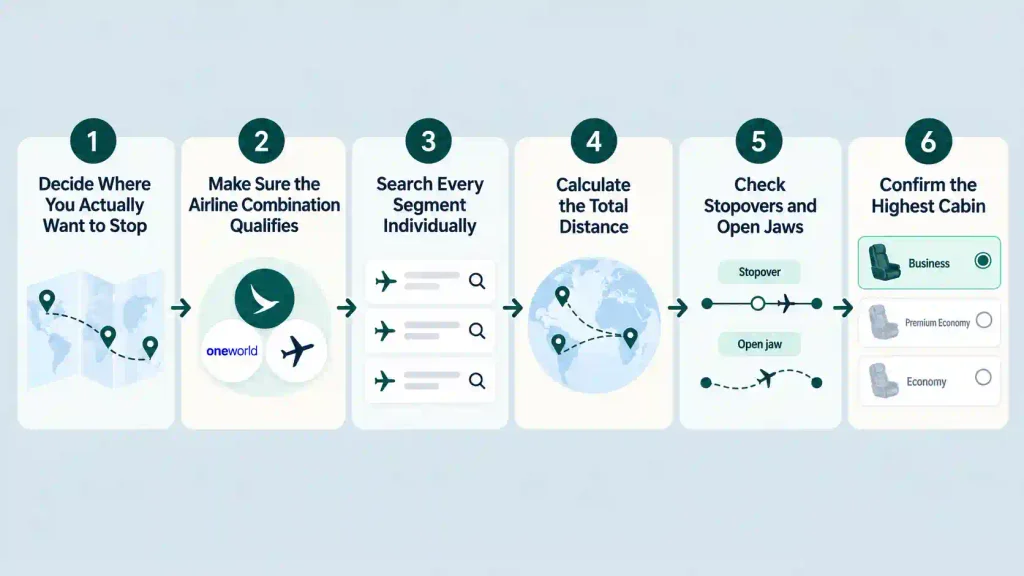
Step 1: Decide Where You Actually Want to Stop
Start with the major destinations. Do not choose airlines first.
For example:
Tokyo → Doha → London → New York → Tokyo
Once the basic journey is clear, look at which oneworld airlines operate each route.
Step 2: Make Sure the Airline Combination Qualifies
Check whether Cathay Pacific is included.
Without Cathay:
At least two oneworld airlines.
With Cathay:
At least three oneworld airlines.
Do this early. You do not want to construct an entire itinerary only to discover that it does not qualify.
Step 3: Search Every Segment Individually
Complex itineraries are easier to build segment by segment.
Use Flightpoints and check:
- Exact dates.
- Operating airline.
- Cabin.
- Number of award seats.
- Alternative nearby dates.
Write down flight numbers and dates for every segment with available award space.
Step 4: Calculate the Total Distance
Add the flown distance of every award-flight segment. The final number determines the pricing band. If you are just above a threshold, reconsider the routing. A small change could move the itinerary into a lower award band.
Step 5: Check Stopovers and Open Jaws
Make sure the completed itinerary does not exceed:
- Five stopovers.
- Two transfers.
- Two open jaws.
Also check that the routing complies with Cathay’s city restrictions.
Step 6: Confirm the Highest Cabin
If even one segment is First Class, the award may price using the First Class column. If the highest segment is Business Class, use Business Class pricing. This makes cabin planning just as important as route planning.
How Do You Book the Award?
Complex partner redemptions may require more manual work than a normal Cathay Pacific award. Cathay says its own flight awards can be booked through its online booking service, while awards involving other flight partners can be requested using its Flight Award Request Form when required.
Before submitting the request, have the complete itinerary prepared.
Keep a list containing:
- Date.
- Origin.
- Destination.
- Airline.
- Flight number.
- Cabin.
- Award availability.
- Number of passengers.
Do not simply ask an agent to build a round-the-world itinerary for you. Find the individual award seats first. This is especially important for premium cabins because availability can disappear while you are rearranging the route.
Do You Need All Segments Available Before Booking?
Ideally, yes. Cathay’s terms state that award tickets are issued after reservations are confirmed and that Flight Awards are not issued for waitlisted flights. A multi-carrier itinerary is therefore much easier when every critical segment already has confirmable award availability.
If one major long-haul flight is missing, consider:
- Moving the trip by a day.
- Reversing the direction.
- Using another oneworld airline.
- Starting from another nearby airport.
- Changing one destination.
- Booking a lower cabin if necessary.
Flexibility is often the difference between an itinerary that works and one that stays theoretical.
Watch Taxes and Carrier Surcharges
The Asia Miles chart only tells you the mileage requirement.
You still pay applicable:
- Government taxes.
- Airport fees.
- Carrier-imposed charges.
- Other ticketing fees.
These can vary significantly depending on the airlines and airports in your routing. An itinerary that looks excellent at 250,000 Asia Miles can lose some appeal if the cash component is unusually high. Compare the total out-of-pocket cost before ticketing rather than focusing exclusively on the number of miles.
Can You Transfer Points After Finding the Seats?
Yes, if you have access to a transferable rewards program that partners with Cathay. But do not transfer points while you are still designing the itinerary. Award transfers are generally one-way, while partner availability can disappear.
A safer order is:
- Build the route.
- Confirm each award segment.
- Calculate the complete distance.
- Check the Asia Miles requirement.
- Confirm taxes and fees.
- Verify your transfer path.
- Transfer only what you need.
- Complete the reservation.
You can also review Flightpoints Award Charts before committing a large points balance.
Is This Better Than Booking Separate Awards?
Not always. A Cathay Pacific oneworld multi carrier award is most compelling when you actually want a complex journey. For a simple Hong Kong-Tokyo return trip, there is little reason to force the ticket into a multi-carrier structure.
It becomes more interesting when you want:
- Several international destinations.
- Multiple oneworld airlines.
- Long-haul Business or First Class.
- Stopovers in several cities.
- An open-jaw itinerary.
- A trip approaching a round-the-world routing.
Separate awards may still be better if they give you:
- Lower mileage pricing.
- Greater flexibility.
- Easier cancellations.
- Better award availability.
- Less risk if one segment changes.
Read Best oneworld Sweet Spots before finalizing the trip. Sometimes one or two individual partner awards can cost fewer miles than forcing everything into a single multi-carrier ticket.
Is the Cathay Pacific oneworld Multi-Carrier Award Worth It?
For a simple trip, probably not. For an ambitious multi-stop journey, it can be one of the most interesting ways to redeem Asia Miles. The Cathay Pacific oneworld multi carrier award allows up to 50,000 miles of total flying, five stopovers, two transfers, and two open jaws while combining several oneworld airlines under one distance-based chart.
Its biggest strengths are flexibility and the ability to combine multiple premium-cabin flights into one award. Its biggest challenges are availability and complexity.
The best strategy is to build the itinerary backwards from award space: find each important long-haul seat, connect those segments logically, calculate the complete distance, and only then move Asia Miles into place.
Discover the True Value of Your Points
Ready to see what your points are really worth? Get Flightpoints Pro and find the cheapest award seat across every program in seconds.
Get Flightpoints ProFAQs
Q: What is a Cathay Pacific oneworld multi carrier award?
A: It is an Asia Miles award that allows several oneworld airlines to be combined into one itinerary, with the mileage requirement based on the total distance flown.
Q: How many airlines do I need for a Cathay oneworld Multi-Carrier Award?
A: You need two oneworld airlines when Cathay Pacific is not included. If Cathay Pacific is included, you need at least three oneworld airlines in total.
Q: What is the maximum distance?
A: The complete itinerary can cover up to 50,000 miles of flown distance.
Q: How many stopovers are allowed?
A: Cathay permits up to five stopovers, plus two transfers and two open jaws on an eligible oneworld Multi-Carrier Award.
Q: Can I book Business Class?
A: Yes. The multi-carrier chart includes Economy, Business Class, and First Class awards.
Q: How are mixed-cabin itineraries priced?
A: The mileage requirement is based on the highest cabin booked anywhere in the itinerary. If your trip contains Business Class and Economy segments, it prices according to the Business Class award level.
Q: Can I include Cathay Pacific and one partner airline?
A: That combination alone does not qualify for the oneworld Multi-Carrier Award. When Cathay Pacific is included, you need three or more oneworld airlines in the itinerary.
Q: Can I waitlist one of the flights?
A: Cathay’s current terms state that award tickets are not issued for waitlisted flights, so confirmable award space is important when constructing the itinerary.
Q: How do I find the flights before booking?
A: Search the important segments individually with Flightpoints, note the operating airlines, flight numbers, cabins, and dates, then combine the available flights into a routing that fits Cathay’s multi-carrier rules.